
Commercial Carpet Pre-Installation Meeting Checklist
Assign buyer, supplier, contractor and installer decisions before carpet tiles or broadloom are released for installation.
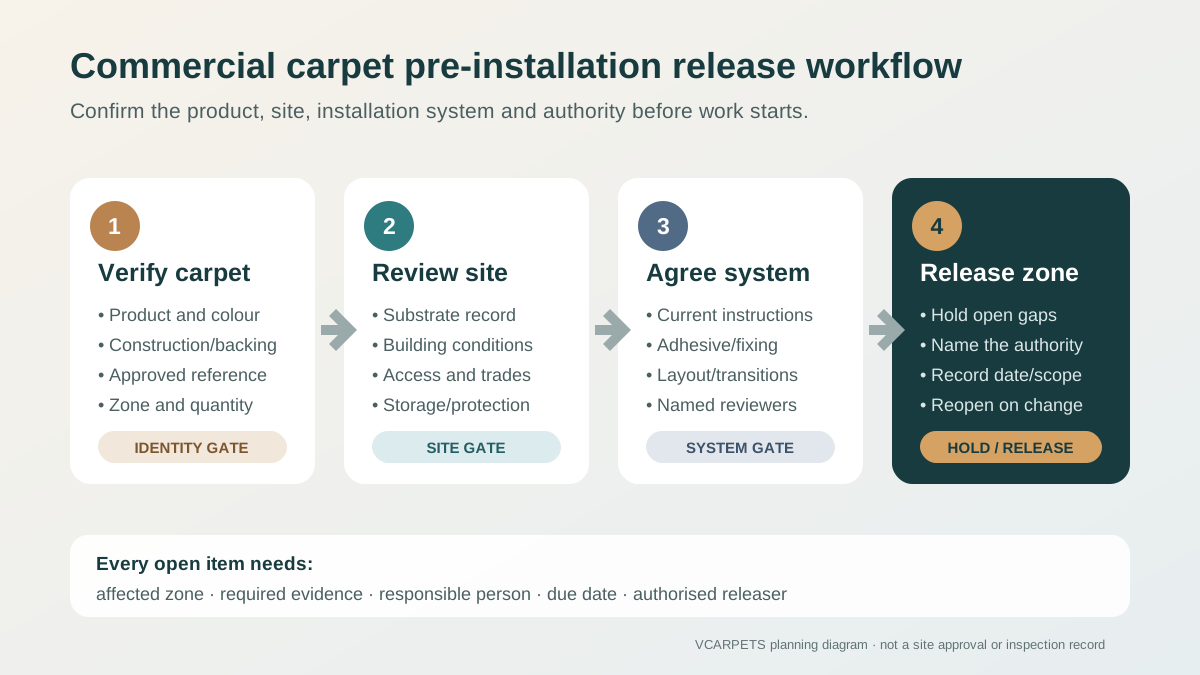
Pain Point Addressed
A carpet order may be correct while installation still starts with an outdated drawing, unresolved substrate, unapproved fixing system or no named person authorised to release the work.
Quick Answer: Release the Carpet, Site and Method Together
A commercial carpet pre-installation meeting should confirm four connected records before work starts: the exact carpet and approved reference, the current site and substrate evidence, the product-specific installation system, and the zone release decision. Assign a named owner and due date to every unresolved item. Do not treat material delivery, sample approval or a verbal site discussion as automatic permission to install.
The meeting is useful for carpet tiles and broadloom in offices, hotels, cinemas and other commercial interiors. Its purpose is coordination and traceability. The signed contract, local project appointments, current product instructions and qualified site decisions control the real installation.
Why One Responsibility Record Prevents Expensive Gaps
Commercial flooring crosses several contracts. The buyer selects and orders material. The designer may control appearance and layout. The main contractor controls access and other trades. A substrate contractor may prepare the floor. The installer judges whether the proposed work can proceed under the nominated instructions. The supplier answers product-specific questions. When those roles remain implicit, one party can assume another has checked moisture, adhesive compatibility, drawing changes, storage or protection.
A recent public flooring discussion about responsibility for subfloor preparation illustrates the confusion buyers face, but one discussion is only a demand signal, not evidence of frequency or a rule for commercial contracts. CRI guidance provides the stronger technical boundary: installation must be planned and coordinated, the owner or general contractor provides an acceptable substrate, and the installer coordinates project details and uses the applicable tools and accessories.
| Risk | What may be missing | Meeting control |
|---|---|---|
| Wrong product or zone | Order, carton and approved sample are not reconciled | Record product, colour/design, construction, available batch reference and destination zone |
| Site not ready | Substrate, building conditions or other trades remain unresolved | Attach the current site record and name the party authorised to accept or correct it |
| System mismatch | Backing, adhesive, primer or preparation is reviewed separately | Approve the exact proposed floor system using current product-specific instructions |
| Layout conflict | Old drawings or unrecorded direction changes reach site | Freeze the current drawing revision and reopen approval after a material change |
| Premature start | Delivery or attendance is treated as release | Use a dated zone status: hold, conditional or released |
Bring These Records to the Meeting
- Commercial scope. Accepted quotation, purchase order, amendments, zone quantities, destination, Incoterm and project milestones that affect the work.
- Product identity. Carpet name or design, colour, construction, tile or roll format, backing, approved sample or artwork reference and current product documents.
- Site record. Substrate type, preparation status, available moisture or alkalinity records, building enclosure and conditioning status, access, lighting and other-trade constraints.
- Installation proposal. Current layout or seaming drawing, direction, transitions, stairs or ramps, fixing or adhesive proposal, primer or mitigation assumptions and product-specific instructions.
- Material status. Delivery inspection, carton or roll identity, held material, site storage, acclimation instructions, spare allocation and damage exceptions.
- Protection and handover. Work sequence, access control, completed-area protection, cleaning handoff, retained records, open issues and named acceptance authority.
If a record does not exist, list it as unavailable or pending. A meeting minute should distinguish verified evidence, a proposal awaiting review and a decision that has actually been released.
Before the first completed zone is opened to later trades, use the commercial carpet protection and handover checklist to name the covering method, permitted traffic, inspection owner, removal trigger, final cleaning and acceptance authority.
Treat every doorway and floor boundary as a separate coordination item when levels, door movement, wheeled traffic or edge protection remain open. Use the commercial carpet floor transition planning checklist to assign a junction ID, compare the complete floor build-ups and record the approved detail before releasing the affected work.
Use a Responsibility Matrix for Each Decision
| Decision | Typical input | Record the actual project owner | Release evidence |
|---|---|---|---|
| Product and sample | Buyer, designer and supplier | Name the approver in the contract workflow | Exact product or design, construction and approved reference |
| Substrate readiness | Owner, general contractor, substrate party and installer | Name who provides, tests, corrects and accepts the substrate | Dated site record and resolved exceptions |
| Fixing system | Installer, carpet supplier and adhesive supplier as applicable | Name who proposes and who approves the complete system | Current instructions and written compatibility decision |
| Layout and transitions | Designer, installer and buyer | Name who controls drawing revisions | Issued drawing with direction, seams and interfaces |
| Material release | Buyer, site team and installer | Name who reconciles delivery identity and holds | Released carton or roll list by zone |
| Start of work | Main contractor, installer and project approver | Name the authorised zone releaser | Dated hold or release status with open conditions |
| Protection and handover | Main contractor, installer and facilities team | Name who protects, inspects and receives the area | Protection record, closeout file and issue log |
These are coordination prompts, not a universal legal allocation. Use the signed contract and actual appointments for the project.
VCARPETS can identify available product, sample, packing and quotation records for a nominated construction. This article does not appoint VCARPETS as the installer, site inspector, substrate tester, consultant or final project approver.
Review the Carpet, Backing, Adhesive and Substrate as One System
A general material label cannot approve a floor system. Carpet tiles with different backings can require different fixing decisions. Broadloom may use different installation methods and seam controls. Old adhesive, primers, levelling compounds, moisture mitigation and raised access panels can change the review. Obtain the current instructions for the exact carpet and nominated installation products, then ask the responsible installer and suppliers to resolve compatibility questions in writing.
CRI 104 treats site and substrate conditions as essential and requires concrete moisture and surface alkalinity results to stay within manufacturer requirements. It also says carpet tile recommendations vary with size, shape, backing and installation method. This article therefore does not copy one moisture limit, adhesive, acclimation time or preparation method into every VCARPETS project.
Use the detailed adhesive and subfloor guide to prepare the product-system questions before this meeting.
Create Hold Points Before Work Begins
| Status | Meaning | Required record |
|---|---|---|
| Hold | A required identity, test, instruction, correction or approval is missing | Open item, owner, due date, affected zone and release authority |
| Conditional | A defined part may proceed while a separate condition remains controlled | Permitted scope, restriction, monitoring and closure action |
| Released | The named project authority has reviewed the required evidence for the identified scope | Zone, drawing revision, product/system record, date and releaser |
| Stopped after release | A new condition, discrepancy or damage has changed the basis of approval | Observation, protected area, persons notified and re-review route |
Do not let the meeting finish with phrases such as “installer to confirm” or “site to check” without a person and date. Do not let a delivery signature become a technical release. The receiving checklist can keep held, released and spare material physically and administratively separate before the installation decision.
Plan Occupied and Phased Projects by Zone
An occupied office, hotel or entertainment venue may require work in several releases. Record the phase boundary, access time, noise or odour restrictions, furniture movement, temporary routes, protection, cleaning and handback for each zone. Confirm that the material identity and layout drawing used in one phase remain valid before the next phase begins.
If site conditions, product, backing, adhesive, preparation, drawing or programme changes, issue a revision and identify which previous decisions must be reopened. A successful first zone is useful evidence for coordination, but it does not erase a changed condition elsewhere.
Copyable Pre-Installation Meeting Agenda and Minute
Attach the referenced documents instead of copying technical limits from memory into the minutes. Mark superseded drawings and instructions clearly. Distribute the record to the people who buy, receive, install, protect and hand over the floor.
Send a Quote-Ready Project Brief
A quotation becomes more useful when the supplier can see the application and the approval path. Send the intended use, area by zone, preferred carpet or appearance, fibre and backing constraints, floor plan or drawing status, substrate type, proposed fixing route, required documents, sample purpose, destination and project timing. Mark unknown fields as preliminary.
| Buyer input | Why it affects the quotation | What to request |
|---|---|---|
| Application and zones | Different areas may have different use and layout requirements | Product options separated by intended zone |
| Area and drawing status | Net area, layout allowance, phases and spares are different quantities | Assumptions and units stated clearly |
| Substrate and fixing route | The complete installation system needs project review | Applicable product instructions and open compatibility questions |
| Samples and documents | A colour swatch, construction sample and technical record answer different questions | Exact sample purpose and product-matched files |
| Destination and timing | FOB shipment planning and site release are separate milestones | Project-confirmed packing, production timing and FOB Tianjin Port basis |
Request a commercial carpet pre-installation planning review through the existing project inquiry path. Include the area, application, destination and target programme so the response can be tied to a real B2B quotation.
Sources and Scope Boundaries
This checklist was informed by the Carpet and Rug Institute's installation information and CRI 104 commercial installation standard, reviewed 30 October 2026. The sources support coordinated planning, defined roles, acceptable substrate conditions, product-specific limits and current installation instructions. Interface installation guidance was reviewed only as an example of product- and backing-specific methods; its products, adhesives, limits and proprietary systems are not VCARPETS specifications.
This is a procurement and coordination framework. It is not a contract allocation, installation instruction, substrate test, site acceptance, warranty, engineering opinion or promise that a nominated system is suitable. The exact quotation, product documents, project contract, local requirements and decisions of the appointed professionals control the work.
Commercial Carpet Pre-Installation Meeting FAQ
Who should attend a commercial carpet pre-installation meeting?
Include the buyer or project approver, main contractor or site representative, flooring installer, designer or specifier where appointed, and the parties responsible for the substrate, building conditions, delivery, storage and protection. Invite the product or adhesive supplier when a product-specific question needs written confirmation.
What should be approved before commercial carpet installation starts?
Confirm the exact carpet and approved sample, current drawing and layout, product-specific installation instructions, substrate and site-condition records, proposed adhesive or fixing system, delivery and storage status, transitions, protection plan, open exceptions and the person authorised to release each zone.
Does the carpet supplier approve the concrete subfloor?
Responsibility depends on the contract and project appointments. CRI guidance assigns provision of an acceptable substrate to the owner or general contractor, while the flooring installer must coordinate and follow the applicable product and system instructions. Record the actual project responsibility instead of assuming the carpet supplier provides site acceptance.
Can one meeting approve every floor or installation phase?
Only if the named scope, conditions and evidence cover every released area. For phased or occupied projects, record the zones, dates, drawings, site conditions, material identities and open actions separately. Reopen the review when a product, backing, adhesive, substrate, layout or site condition changes.
Should installation continue when moisture or compatibility evidence is missing?
Do not convert a missing record into an assumed pass. Place the affected zone or decision on hold, name the required test or written confirmation, assign an owner and deadline, and record who may release the work after the evidence is reviewed under the project procedure.
What information should a buyer send VCARPETS before requesting a quotation?
Send the application, product or design preference, area by zone, floor plan or current drawing status, substrate type, intended fixing route, destination, project timing, sample needs and required product documents. VCARPETS can confirm available product and commercial records for the specific quotation; local site and installation approval remains project-specific.
Buyer Questions
Frequently Asked Questions
Who should attend a commercial carpet pre-installation meeting?
Include the buyer or project approver, main contractor or site representative, flooring installer, designer or specifier where appointed, and the parties responsible for the substrate, building conditions, delivery, storage and protection. Invite the product or adhesive supplier when a product-specific question needs written confirmation.
What should be approved before commercial carpet installation starts?
Confirm the exact carpet and approved sample, current drawing and layout, product-specific installation instructions, substrate and site-condition records, proposed adhesive or fixing system, delivery and storage status, transitions, protection plan, open exceptions and the person authorised to release each zone.
Does the carpet supplier approve the concrete subfloor?
Responsibility depends on the contract and project appointments. CRI guidance assigns provision of an acceptable substrate to the owner or general contractor, while the flooring installer must coordinate and follow the applicable product and system instructions. Record the actual project responsibility instead of assuming the carpet supplier provides site acceptance.
Can one meeting approve every floor or installation phase?
Only if the named scope, conditions and evidence cover every released area. For phased or occupied projects, record the zones, dates, drawings, site conditions, material identities and open actions separately. Reopen the review when a product, backing, adhesive, substrate, layout or site condition changes.
Should installation continue when moisture or compatibility evidence is missing?
Do not convert a missing record into an assumed pass. Place the affected zone or decision on hold, name the required test or written confirmation, assign an owner and deadline, and record who may release the work after the evidence is reviewed under the project procedure.
What information should a buyer send VCARPETS before requesting a quotation?
Send the application, product or design preference, area by zone, floor plan or current drawing status, substrate type, intended fixing route, destination, project timing, sample needs and required product documents. VCARPETS can confirm available product and commercial records for the specific quotation; local site and installation approval remains project-specific.
Turn This Guide Into a Quote
Send Your Project Requirements After Reading This Guide
If this topic matches your project, send the carpet application, estimated area, destination, and required date. VCARPETS can recommend the related product path and reply with sample, MOQ, lead time, and quotation details.
Email: sales@vcarpets.com
Continue Your Specification
Related Products


Browse the Full Range
Related Product Categories
Product Category
Commercial Carpet Tiles
Modular commercial carpet tiles for offices, hotels, corridors, education, and phased replacement programs.
View Category →
Product Category
Wall-to-Wall Carpets
Custom broadloom carpet for guestrooms, corridors, lobbies, ballrooms, and branded hospitality interiors.
View Category →