
Axminster vs Wilton vs Tufted Carpet for Hotel Projects
Compare construction, pattern approval, product evidence and quotation scope before choosing hospitality broadloom.
Pain Point Addressed
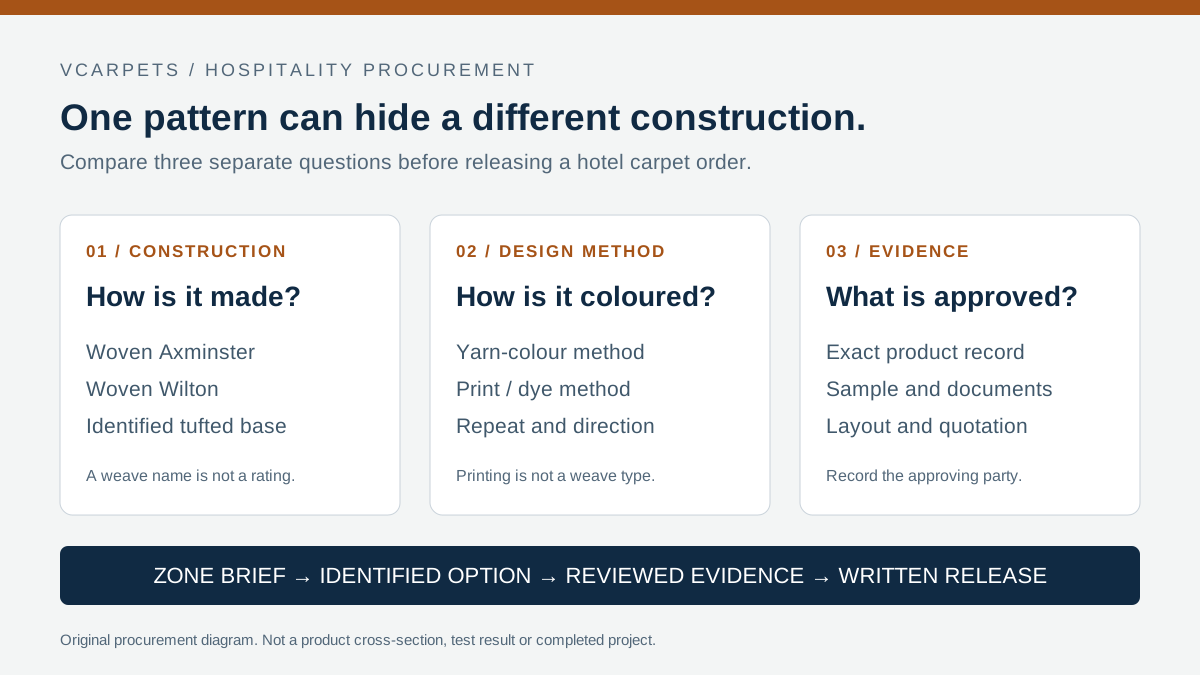
A similar pattern can hide a different carpet construction. Hotel buyers need a way to compare proposals without assuming that a weave name, price or screen image proves equivalence.
The Answer: Compare the Product Behind the Construction Name
Axminster and Wilton are woven constructions; tufting inserts pile yarn through a primary backing. Printing is a colouring method, not a competing weave. Choose hotel carpet by the quoted construction, sample, project requirements and installed scope rather than assuming one name guarantees durability or lower cost.
For hotel developers, hospitality designers, fit-out contractors and importers, the decision is a specification task. Define the use zone first, compare identified products against the same requirements, and keep alternatives visible in the quotation. A corridor, guestroom and ballroom can need different appearance, maintenance and installation decisions within one property.
Separate Three Questions: Structure, Colour and Evidence
- How is the carpet made? Record woven Axminster, woven Wilton or the nominated tufted construction, including pile and backing details.
- How is the design produced? Record the yarn-colour or printing route, artwork revision, repeat and orientation. A printed appearance does not identify the base structure.
- What supports the proposed use? Connect the exact product reference to required documents, the physical sample and the installer’s review.
The Carpet and Rug Institute distinguishes manufacturing construction from dyeing and printing. Bloomsburg’s weave resource describes Axminster and Wilton separately. Tarkett’s Gravure page supplies a concrete example of a printed design applied to a tufted base. These sources establish terminology; their product capabilities are not specifications for a VCARPETS order.
Axminster, Wilton and Tufted Carpet: Procurement Comparison
| Comparison | Axminster | Wilton | Tufted / printed tufted |
|---|---|---|---|
| Structure | Woven construction with selected pile tufts bound into the structure. | Woven construction; the nominated weave can create cut pile, loop pile or a combination. | Pile yarn is inserted through primary backing; specify the finishing and backing system. |
| Design question | Confirm yarn colours, repeat, density and the approved weaving design. | Confirm the actual weave, pile texture, colours and repeat available for the selected product. | Confirm whether the pattern comes from yarn arrangement, printing or another declared method. |
| Sample to review | Identified construction sample and the project design approval reference. | Sample of the exact proposed texture and weave, rather than a generic woven swatch. | Identified base construction plus the pattern and colour approval reference. |
| Evidence needed | Applicable documents for the quoted fibre, construction and backing. | Applicable documents for the quoted fibre, construction and backing. | Applicable documents for the quoted fibre, construction and backing. |
| Price and programme | Obtain a written proposal for the same area, design and approval scope. | Obtain a written proposal for the same area, design and approval scope. | Obtain a written proposal for the same area, design and approval scope. |
| VCARPETS next step | Review the listed Axminster product and confirm the selected configuration. | Submit the required Wilton specification for feasibility review; this guide is not a Wilton stock offer. | Review the listed printed or guestroom broadloom and confirm its actual construction. |
This is a construction and procurement comparison, not a ranking of service life or a claim that all three options meet the same project specification.
The VCARPETS Axminster catalog reference identifies 80% wool / 20% nylon and a nominal 4 m roll width. Those values describe that listed option, not every Axminster or Wilton carpet. The custom printed nylon hotel carpet also has its own catalog and sample path. Use the Axminster hotel carpet and custom printed nylon hotel carpet pages to identify the options before requesting a comparable quote.
Match the Construction Review to the Hotel Zone
| Zone | Buyer information to supply | Decision to record |
|---|---|---|
| Guestrooms and suites | Room types, furniture, cleaning access, appearance brief and refurbishment phases. | One configuration and sample reference per room type, with a documented replacement plan. |
| Corridors and lift lobbies | Trolley routes, turns, entrances, thresholds, lighting and measured widths. | Pattern direction, seam locations, transitions and installer-reviewed cutting assumptions. |
| Ballrooms and meeting spaces | Partition lines, event layouts, seating movement and large-pattern intent. | Artwork scale, focal alignment, room boundaries and the relevant use requirements. |
| Reception and connected public areas | Entrance soil, circulation, cleaning arrangements and adjoining finishes. | Transition details and a sample review under the intended lighting. |
The zone map defines what must be reviewed; it does not certify a particular construction for that use.
For a room programme, connect the selection to the hotel guestroom order schedule. For performance and document review, use the hotel carpet procurement documents checklist. Keep the hotel operator, designer and installer aligned on the same product revision.
Read Density and Pile Weight Without Inventing an Equivalence
A woven proposal may state pitch and rows, while a tufted proposal may state gauge and stitch rate. Ask for units and the supplier’s explanation of the nominated values. Do not compare an unlabelled density number across processes or treat it as a standalone durability score. Pile weight, total weight, pile height and total thickness also describe different quantities.
Where a tender specifies fibre composition, use class, fire performance, emissions or acoustics, identify the applicable evidence and its construction mapping. A report for one backing or assembly does not automatically cover another. If a required document is missing, record the gap and the approving party instead of marking the option compliant.
Approve Pattern, Repeat and Seams as a Separate Workstream
A digital design can support discussion, but it does not approve colour, physical texture or a finished room. Identify the sample’s purpose: yarn or colour reference, construction review, pattern strike-off or a project mock-up. Record the design revision, viewing conditions, open actions and named approver. Confirm the required sample format before paying for development.
For every broadloom option, ask how the approved repeat and direction relate to measured rooms, corners, door positions and access routes. Roll width alone cannot establish seam count or final ordering quantity. Separate net area, installer-reviewed cutting and matching allowances, and retained spare material. Do not apply a universal waste percentage to all hotel layouts.
The pattern repeat and seam planning guide explains this layout workstream in detail for printed broadloom. The physical sample approval checklist helps record what has and has not been approved.
Compare Cost and Programme on One Written Scope
There is no construction-wide price or lead-time ranking that can replace comparable offers. Request separate lines for the selected product, design development, samples, required evidence, cutting assumptions, packing and retained stock. State quantity by design and colour, not only the combined property area. Record what is included, excluded and awaiting confirmation.
For timing, ask which approvals and commercial milestones start the quoted production period. Keep artwork review, sample decisions, required documents, production, freight and site access visible as separate dependencies. VCARPETS supplies B2B orders FOB Tianjin Port. Sample format, charges, production timing and current availability are confirmed for the individual proposal.
Use the FOB Tianjin Port buyer checklist to align the quotation basis and buyer-arranged logistics. A material quote is not a complete installed-cost estimate.
Record Any Proposed Construction Change Before Ordering
If a supplier proposes printed tufted carpet against a woven requirement, or changes fibre, backing, width or pattern, show the difference explicitly. A similar visible design is insufficient for approval. Give the designer, buyer and installer one revision record containing the following fields.
| Record | What to enter |
|---|---|
| Original requirement | Tender or drawing reference, hotel zone and specification revision. |
| Proposed option | Product identity, construction, fibre, backing, dimensions and design revision. |
| Changed evidence | Sample reference, required documents and any installation or maintenance difference. |
| Quantity and commercial effect | Revised layout assumptions, price scope and programme dependencies. |
| Decision | Named approving party, date, conditions and whether the affected order may proceed. |
This is a procurement record structure. Project approval remains with the responsible parties.
Send a Construction-Specific Hotel Carpet RFQ
- Use and quantity: hotel zone, estimated square metres, room count, phases and destination.
- Construction: required weave or tufted base, fibre, backing and mandatory specification; identify whether alternatives may be proposed.
- Design: artwork, colour references, repeat, direction and drawings with revisions.
- Evidence: required product data, reports, sample format and the approval owner.
- Programme: design-review date, target shipment, site access and installation dates.
Browse the commercial broadloom category to shortlist a listed option, then request a hotel carpet construction review with your project brief. State any requirement that must remain unchanged so a different construction is not silently quoted as equivalent.
Sources and Scope
Reviewed 23 October 2026. The Carpet and Rug Institute’s business selection guide supports the distinction between construction and colouring methods. Bloomsburg’s Weave Structures resource explains the Axminster and Wilton processes. Tarkett’s DESSO Gravure page demonstrates printing on a tufted carpet surface. Links to the primary sources are provided below. No competitor’s colour limit, width, performance, price or production promise is transferred to VCARPETS.
The selection tables, revision record and RFQ sequence are editorial procurement guidance. The VCARPETS product values are existing catalog references and still require confirmation for the selected order. This guide does not replace product instructions, project specifications or the responsible project team’s approval.
Hotel Carpet Construction FAQ
What is the difference between Axminster, Wilton and tufted carpet for a hotel project?
Axminster and Wilton are different woven constructions. Tufting inserts pile yarn through a primary backing. Compare the actual fibre, pile, backing, dimensions and product evidence for the hotel zone. A construction name alone does not establish service life, fire classification or installed cost.
Is printed hotel carpet the same construction as Axminster carpet?
No. Printing describes how colour or pattern is applied; Axminster describes a weaving construction. Printed carpet can use a tufted base. Identify both the base construction and the colouring method in the quotation, then approve a physical sample and artwork revision.
Is Axminster always more durable than Wilton or tufted hospitality carpet?
A universal ranking is not justified by the construction name. Compare identified products under the same traffic, maintenance and installation assumptions using applicable product data and test evidence. Do not convert a fibre blend, pile-weight figure or supplier description into a guaranteed service life.
Can a printed carpet replace a specified woven hotel carpet without further approval?
Treat the change as a proposed alternative. Show the original requirement, proposed construction, sample, design revision, applicable documents, quantity plan and commercial difference. Obtain the named project approver’s written decision before releasing the changed order. Matching the visible pattern does not establish equivalence.
Does a 4 m broadloom width mean a hotel corridor will have no seams?
No. A nominal width is one input to a cutting plan. Corridor geometry, turns, pattern repeat, direction, thresholds and handling access also matter. Have the installer review the measured plan and separate net floor area, cutting allowance and retained spare material.
What should I send VCARPETS for an Axminster or printed hotel carpet quotation?
Send hotel zones, estimated area, floor plans, required construction, fibre or backing preferences, artwork and colour references, required documents, destination and target dates. State whether alternatives are allowed. VCARPETS quotes B2B supply FOB Tianjin Port; selected specifications, samples, fees and timing require written project confirmation.
Buyer Questions
Frequently Asked Questions
What is the difference between Axminster, Wilton and tufted carpet for a hotel project?
Axminster and Wilton are different woven constructions. Tufting inserts pile yarn through a primary backing. Compare the actual fibre, pile, backing, dimensions and product evidence for the hotel zone. A construction name alone does not establish service life, fire classification or installed cost.
Is printed hotel carpet the same construction as Axminster carpet?
No. Printing describes how colour or pattern is applied; Axminster describes a weaving construction. Printed carpet can use a tufted base. Identify both the base construction and the colouring method in the quotation, then approve a physical sample and artwork revision.
Is Axminster always more durable than Wilton or tufted hospitality carpet?
A universal ranking is not justified by the construction name. Compare identified products under the same traffic, maintenance and installation assumptions using applicable product data and test evidence. Do not convert a fibre blend, pile-weight figure or supplier description into a guaranteed service life.
Can a printed carpet replace a specified woven hotel carpet without further approval?
Treat the change as a proposed alternative. Show the original requirement, proposed construction, sample, design revision, applicable documents, quantity plan and commercial difference. Obtain the named project approver’s written decision before releasing the changed order. Matching the visible pattern does not establish equivalence.
Does a 4 m broadloom width mean a hotel corridor will have no seams?
No. A nominal width is one input to a cutting plan. Corridor geometry, turns, pattern repeat, direction, thresholds and handling access also matter. Have the installer review the measured plan and separate net floor area, cutting allowance and retained spare material.
What should I send VCARPETS for an Axminster or printed hotel carpet quotation?
Send hotel zones, estimated area, floor plans, required construction, fibre or backing preferences, artwork and colour references, required documents, destination and target dates. State whether alternatives are allowed. VCARPETS quotes B2B supply FOB Tianjin Port; selected specifications, samples, fees and timing require written project confirmation.
Turn This Guide Into a Quote
Send Your Project Requirements After Reading This Guide
If this topic matches your project, send the carpet application, estimated area, destination, and required date. VCARPETS can recommend the related product path and reply with sample, MOQ, lead time, and quotation details.
Email: sales@vcarpets.com
Continue Your Specification
Related Products

Browse the Full Range