
Commercial Carpet Protection and Handover Checklist
Control construction traffic, temporary covering, inspection, cleaning and final release after carpet installation.
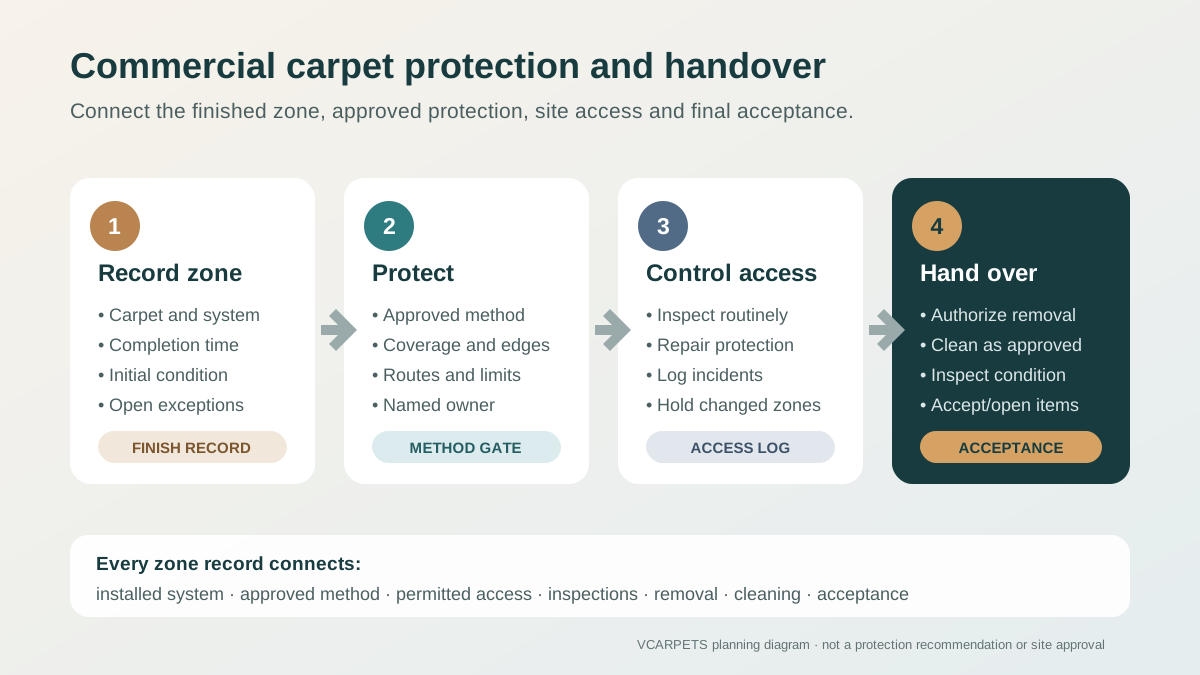
Pain Point Addressed
A correctly supplied and installed carpet can still reach handover with construction dust, wheel damage, stains, shifted tiles or disputed responsibility when protection is treated as an informal site task.
Direct Answer: Protect Each Finished Zone until Formal Handover
A commercial carpet protection plan should identify the finished zone, exact installed carpet and attachment system, approved temporary protection, permitted traffic, prohibited work, inspection routine, damage response, removal trigger, final cleaning and named handover authority. Start the record before installation and keep it active until the project accepts the area. A verbal request to ‘cover the carpet’ is not a complete control.
The chosen method must suit the nominated carpet, backing, adhesive or other fixing system, site conditions, movement routes and remaining trades. This article organizes buyer and project decisions. The current product and installation instructions, protection-material instructions, signed contract and competent local site review govern the actual work.
Why Protection Is a Procurement Decision, Not a Last-Minute Cover
The Carpet and Rug Institute's CRI 104 commercial installation standard warns that installing before other trades finish can lead to appearance problems, visible damage, soiling, adhesive failure, delamination and dimensional instability. UFGS 09 68 00 separately addresses post-installation cleaning, temporary protection, traffic restriction and protection removal. A 2026 public carpet-tile specification also requires protection against construction operations and equipment placement for the remainder of construction.
One commercial-construction discussion described newly carpeted corridors in an occupied multi-floor building used by residents, wheelchairs, carts and later trades. The practical questions were cost, replacement frequency, slip or trip exposure and responsibility for damage. That post is one demand clue, not evidence of frequency, a specification or a safe method. The cited industry and project documents provide the stronger technical basis for requiring a written plan.
| Uncontrolled event | Possible project effect | Required planning record |
|---|---|---|
| Early foot traffic | Tile movement, adhesive disturbance, soiling or disputed curing conditions | Zone release time, allowed users and current system instructions |
| Carts, lifts or furniture | Concentrated loads, wheel marks, displacement, edge or transition damage | Route, load review, protective distribution method and supervisor |
| Painting, ceiling or joinery work | Dust, overspray, spills, offcuts and tool damage | Prohibited activities, work permit, coverage and cleanup owner |
| Wet or sealed covering | Moisture or residue concern for some systems | Written compatibility review and inspection/removal triggers |
| Uncontrolled removal | Damage revealed too late or protection debris left at handover | Removal date, condition record, cleaning and acceptance authority |
These are coordination risks. They do not diagnose a defect or establish a universal protection product, load limit or curing time.
Build the Protection Schedule before Installation Starts
| Schedule field | Question to answer | Evidence or decision |
|---|---|---|
| Zone and carpet | Which room, floor or drawing area is covered, and which carpet/system is installed? | Drawing revision, product identity and completion date |
| Protection purpose | Is the risk dust, light traffic, wheeled traffic, equipment, liquid or several conditions? | Remaining-work and route assessment |
| Approved method | Which covering, board, runner or other method is compatible and who approved it? | Written product/system guidance and named reviewer |
| Edges and interfaces | How are seams, perimeter, doors, ramps, stairs and transitions kept safe and visible? | Detail, access check and inspection point |
| Traffic status | Who may enter, what may move, and when does the restriction change? | Hold, limited access or released status |
| Inspection | Who checks the protection and installed area, how often and after which events? | Dated log with exceptions and actions |
| Removal and handover | Who authorizes removal, cleaning, issue closure and final acceptance? | Condition record, open-item list and acceptance |
Add this schedule to the pre-installation meeting instead of deciding it after the first area is finished. The pre-installation checklist assigns the carpet, site, installation system and zone-release decisions that must be known before a protection method can be reviewed.
Match the Method to the Exact Carpet System and Site Risk
Do not specify protection by generic material name alone. Review whether it can stain, transfer residue, trap moisture, interfere with curing, move under wheels, damage pile, mark seams or create unsafe edges. Also check the protection manufacturer's limits, removal period and substrate compatibility. A method suitable for one carpet tile and adhesive system may be unsuitable for another broadloom, cushion or site condition.
Shaw's published carpet-tile guidance is a useful example of product-specific boundaries: it describes non-staining building paper for continuing construction, plywood when heavy objects move, and warns against plastic sheeting because it can trap moisture. Those instructions apply to the products and systems covered by that document. They are not VCARPETS instructions and should not be copied to an unrelated construction without review.
| Project condition | Protection review | Do not assume |
|---|---|---|
| Light controlled access | Dust, shoe traffic, seams, permitted duration and daily inspection | A thin covering remains secure or nonstaining for any duration |
| Carts or wheeled equipment | Route, turning points, transitions, load distribution and supervision | A paper layer alone controls concentrated loads |
| Occupied building | Accessible route, door operation, emergency egress, noise, cleaning and daily reopening | Protection edges are acceptable because they are temporary |
| Wet work or liquid risk | Exclusion, containment, removal and incident response | A sealed sheet is compatible with curing or moisture movement |
| Long protection period | Manufacturer limits, replacement triggers, trapped debris and concealed condition checks | The protection can stay untouched until final handover |
Assign Protection, Access and Damage Responsibilities
| Decision | Typical project input | Record the actual owner | Closeout evidence |
|---|---|---|---|
| Protection method | Installer, main contractor and relevant product/system guidance | Person who proposes and person who approves | Approved method and revision |
| Installation and repair | Flooring installer or assigned protection trade | Person who places, secures, repairs and replaces protection | Completion and repair log |
| Access control | Main contractor, building operator and safety/access review | Person who authorizes users, routes and equipment | Access status and incident record |
| Daily inspection | Site supervisor and flooring representative as appointed | Person who checks edges, coverage, contamination and damage | Dated inspection entries |
| Incident response | Contract and project procedure | Person who isolates, records, notifies and decides correction | Location, photographs, cause status and disposition |
| Removal and cleaning | Installer, cleaning party and project manager | Person who authorizes removal and accepts the cleaning method | Removal and cleaning record |
| Final handover | Buyer, consultant, project manager or facilities team as appointed | Named acceptance authority | Accepted zones and open-item register |
The table is a coordination prompt. The signed contract and actual project appointments allocate responsibility.
VCARPETS supplies bulk commercial carpet on the project quotation basis, generally FOB Tianjin Port. A carpet quotation does not automatically include local measurement, installation, temporary protection, site safety control, cleaning or final acceptance. Put those local responsibilities in the tender and installer scope instead of leaving them between buyer and supplier assumptions.
Control Access and Inspect the Protection by Zone
- Photograph or record the area before covering. Identify the zone, date, installed product and any existing exception. This separates pre-existing issues from later site damage without claiming the photograph proves hidden conditions.
- Post the access status. State hold, limited access or released; identify the allowed route, users and equipment. Keep current status visible to parties entering the area.
- Inspect after defined events. In addition to the agreed routine, review after deliveries, furniture moves, wet work, protection repair, unusual traffic or a reported incident.
- Separate protection failure from carpet assessment. Record lifted edges, gaps, contamination or wet material immediately. If the carpet may be affected, isolate the location and route the observation to the appointed flooring and project reviewers.
- Close every exception. Name the responsible party, decision deadline and disposition. Do not cover an unresolved condition again without retaining the location and issue record.
Separate Removal, Final Cleaning, Inspection and Handover
Protection removal can expose concealed debris, stains, adhesive transfer, pressure marks or damage. Remove it under the agreed sequence, inspect the area before other work resumes, and use the cleaning method applicable to the exact carpet. UFGS 09 68 00 gives one public-project example: remove debris and foreign matter, address spots and adhesive appropriately, trim protruding face yarn and vacuum with HEPA filtration. Treat that as a specification example, not a universal VCARPETS procedure.
| Gate | Decision | Minimum record |
|---|---|---|
| Protection removal | The named authority permits removal in the identified zone | Date, zone, removal party and visible exceptions |
| Final cleaning | The cleaning method matches the nominated carpet and project requirement | Method or instruction reference, responsible party and completion |
| Condition inspection | The appointed reviewer records accepted condition and open items | Location, observation, evidence reference, owner and deadline |
| Operational handover | Facilities or the named receiver accepts the area and operating records | Acceptance date, maintenance file, spare stock and open issues |
Move the accepted condition, open-item list, maintenance file and spare-stock record into the commercial carpet project closeout pack. Cleaning completion alone does not close unresolved damage, workmanship or product questions.
Copyable Commercial Carpet Protection and Handover Record
Attach current documents and photographs or marked drawings where the project requires them. Mark superseded methods and access plans clearly. Keep the record with the people who install, supervise later trades, clean, inspect and receive the carpet.
Send a Protection-Aware Carpet Project Inquiry
For a useful product and quotation discussion, send the building use, carpet zones, estimated area, preferred carpet or appearance, tile or broadloom format, substrate and installation status if known, destination, project programme, expected occupied or construction traffic, sample needs and required product documents. State whether the project needs phased packing or floor/zone labels. Mark preliminary inputs as provisional.
| Inquiry field | Why it matters | Project confirmation |
|---|---|---|
| Application and zones | Connects product discussion to real traffic and use | Office, hotel, cinema or other commercial area by zone |
| Area and programme | Separates estimated product demand from local protection duration | Net area or quantity status, phase and target receiving date |
| Product preference | Prevents one protection assumption being applied to a different construction | Carpet type, backing, format, colour/design and sample reference |
| Site sequence | Shows whether later trades or occupied access remain | Installation, other-trade, protection removal and handover milestones |
| Document needs | Lets the supplier identify what is available for the nominated construction | Product, sample, packing and project-specific record requests |
Use the existing inquiry route to request commercial carpet project protection planning. Include the application, area, destination and required date so the sales response can address a real bulk quotation. Sample format, cost, timing, MOQ and production timing require confirmation for the actual product and project.
Sources and Scope Boundaries
Evidence was reviewed on 5 November 2026. CRI 104 supports coordinated site conditions and identifies risks when other trades remain. UFGS 09 68 00 provides a public-project example of cleaning, continuous nonstaining protection and traffic restriction. A 2026 public carpet-tile specification requires protection from later construction and equipment. Shaw guidance illustrates why the method must be checked against the actual carpet-tile system. The Reddit construction post was used only as a buyer-problem clue.
These sources are not VCARPETS product certificates, warranty terms or proof that one material, traffic restriction, cleaning method or responsibility allocation fits every project. The exact quotation, supplied construction, current instructions, signed contract, local requirements and decisions of the appointed project parties control the work.
Commercial Carpet Protection and Handover FAQ
Who is responsible for protecting newly installed commercial carpet?
The contract and project appointments should name the responsible party. Record who selects the protection method, installs it, controls access, inspects it, replaces damaged protection, removes it, cleans the carpet and accepts the final area. Do not assume that product supply includes local site protection or handover.
Can plastic sheeting be used over every carpet tile installation?
Do not treat one covering as universal. Protection must be compatible with the exact carpet, backing, attachment system, curing conditions and project risks. Some published carpet-tile instructions warn that plastic can trap moisture. Obtain written guidance for the nominated system and have the responsible site parties approve the method.
How long should traffic be restricted after carpet installation?
Follow the current instructions for the exact carpet and installation system. Public specifications may state project-specific restrictions, but those examples are not universal VCARPETS curing periods. Record the permitted traffic, start time, release time and authority for each zone.
What should a carpet protection schedule include?
Identify the zone, installed carpet and system, protection purpose, approved material or method, coverage and edge detail, permitted traffic, prohibited activities, access route, inspection frequency, repair owner, removal trigger, cleaning method, condition photographs or record, and the persons responsible for release and handover.
Is final cleaning the same as accepting the carpet installation?
No. Cleaning removes construction debris and soiling; acceptance records the agreed condition and any open workmanship, damage or product issues. Keep the protection removal, final cleaning, condition inspection and formal handover as separate dated decisions.
What should a buyer send VCARPETS for a protection-aware quotation?
Send the application, carpet type or product preference, area by zone, destination, project stage, installation and handover programme, expected site traffic, sample and document needs, and any packing or phased-delivery requirements. VCARPETS confirms bulk carpet supply, available product records, samples and commercial terms for the quoted construction; local protection and installation responsibilities remain project-specific.
Buyer Questions
Frequently Asked Questions
Who is responsible for protecting newly installed commercial carpet?
The contract and project appointments should name the responsible party. Record who selects the protection method, installs it, controls access, inspects it, replaces damaged protection, removes it, cleans the carpet and accepts the final area. Do not assume that product supply includes local site protection or handover.
Can plastic sheeting be used over every carpet tile installation?
Do not treat one covering as universal. Protection must be compatible with the exact carpet, backing, attachment system, curing conditions and project risks. Some published carpet-tile instructions warn that plastic can trap moisture. Obtain written guidance for the nominated system and have the responsible site parties approve the method.
How long should traffic be restricted after carpet installation?
Follow the current instructions for the exact carpet and installation system. Public specifications may state project-specific restrictions, but those examples are not universal VCARPETS curing periods. Record the permitted traffic, start time, release time and authority for each zone.
What should a carpet protection schedule include?
Identify the zone, installed carpet and system, protection purpose, approved material or method, coverage and edge detail, permitted traffic, prohibited activities, access route, inspection frequency, repair owner, removal trigger, cleaning method, condition photographs or record, and the persons responsible for release and handover.
Is final cleaning the same as accepting the carpet installation?
No. Cleaning removes construction debris and soiling; acceptance records the agreed condition and any open workmanship, damage or product issues. Keep the protection removal, final cleaning, condition inspection and formal handover as separate dated decisions.
What should a buyer send VCARPETS for a protection-aware quotation?
Send the application, carpet type or product preference, area by zone, destination, project stage, installation and handover programme, expected site traffic, sample and document needs, and any packing or phased-delivery requirements. VCARPETS confirms bulk carpet supply, available product records, samples and commercial terms for the quoted construction; local protection and installation responsibilities remain project-specific.
Turn This Guide Into a Quote
Send Your Project Requirements After Reading This Guide
If this topic matches your project, send the carpet application, estimated area, destination, and required date. VCARPETS can recommend the related product path and reply with sample, MOQ, lead time, and quotation details.
Email: sales@vcarpets.com
Continue Your Specification
Related Products


Browse the Full Range
Related Product Categories
Product Category
Commercial Carpet Tiles
Modular commercial carpet tiles for offices, hotels, corridors, education, and phased replacement programs.
View Category →
Product Category
Wall-to-Wall Carpets
Custom broadloom carpet for guestrooms, corridors, lobbies, ballrooms, and branded hospitality interiors.
View Category →