
Commercial Carpet Purchase Order and Production Release Checklist
Turn an approved sample and quotation into one controlled order record before a bulk commercial carpet project moves forward.
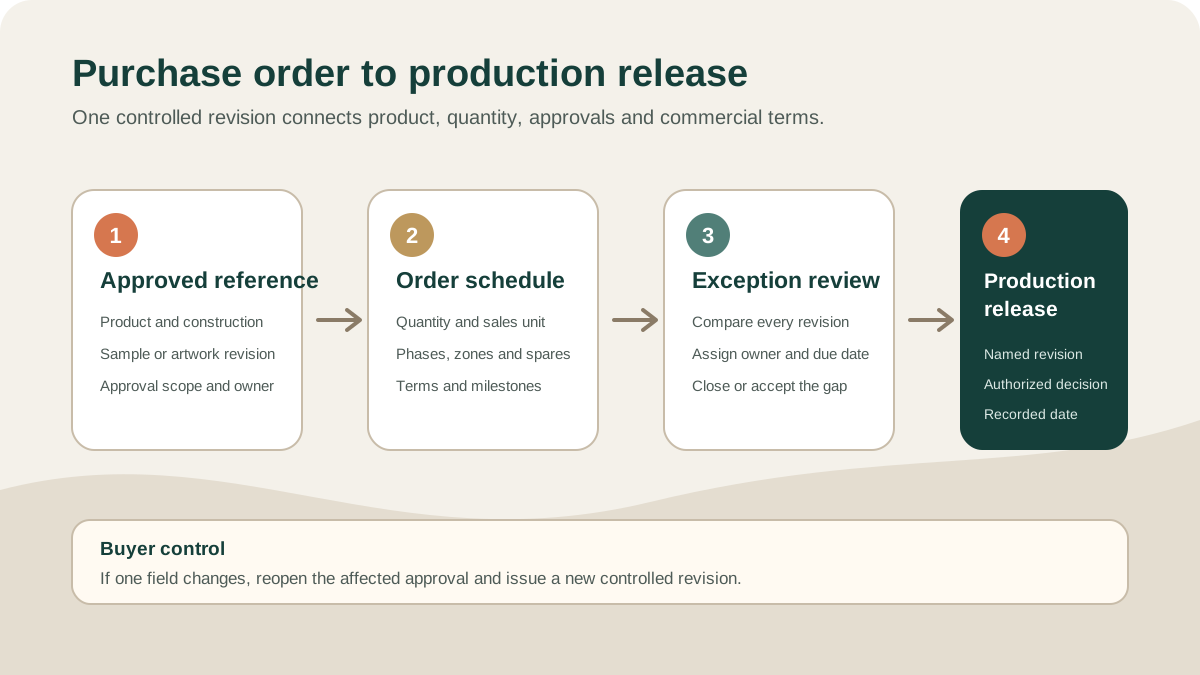
Pain Point Addressed
A buyer can approve a carpet appearance while product construction, quantity units, artwork revision, packing, trade terms or release conditions still disagree across the quotation and purchase order.
Quick Answer: Release One Controlled Order Revision
Before releasing a commercial carpet order, make the purchase order, accepted quotation or pro forma invoice, approved sample or artwork record and order schedule agree. Use the same product identity, construction, colour or design revision, quantity, sales unit, trade term, named shipment point and required milestones. Record any difference as an open exception with an owner and decision date.
Production release should identify exactly which revision the buyer authorizes. It should not be inferred from a sample courier receipt, an informal message, a deposit alone or a purchase order that still contains incompatible assumptions. The supplier must confirm which event starts the quoted production timing for the selected product and order.
Make Four Records Describe the Same Carpet Order
Trade.gov explains that a pro forma invoice should give the buyer enough order information to arrange the transaction efficiently, including items, prices, terms of sale, payment terms and an estimated shipping date. Its export-document guidance also connects the goods description, quantity, price, weight and other specifications to the future commercial invoice. Use those records with the buyer's PO and approval file rather than treating any one document as complete by itself.
| Record | What it should control | Cross-check before release |
|---|---|---|
| Purchase order | Buyer identity, line items, quantity, currency, required dates, delivery basis and approval authority | Matches the supplier's accepted commercial revision and uses the same units |
| Quotation or pro forma invoice | Seller identity, exact offered configuration, unit and total price, validity, payment, packing and trade term | All buyer changes are incorporated or listed as exceptions |
| Approved sample or artwork record | The appearance, construction or design decisions actually accepted | Reference and revision match the ordered product; approval limits remain visible |
| Order schedule and release record | Zones or phases, milestones, dependencies, open items, decision owners and release status | The named release event and authorized revision are unambiguous |
Document names vary by buyer and contract. The control is that the transaction and approval references agree, not that every project uses one template.
Write a Carpet Line Item That Can Be Checked
A line such as 'blue commercial carpet' cannot control a project order. Use the supplier's verified product or design reference and describe only the construction that has been quoted and reviewed. If a field is still subject to confirmation, identify it as open instead of copying a value from another SKU or a marketplace listing.
- Product identity: product or design name/reference, tile or broadloom format and the applicable quotation revision.
- Construction: confirmed fibre, pile, backing, nominal size or width and other required product fields supported by the selected item.
- Appearance: colour, colourway, artwork or pattern revision; repeat and direction where relevant; approved reference identifier.
- Quantity and unit: ordered quantity for each line and phase, sales unit, conversion basis, allowance and retained spares shown separately.
- Document scope: product-specific records the buyer requires, their due stage and any unavailable or pending evidence.
- Packing identity: required buyer/project marks, zone allocation and draft label or packing-list review when applicable.
An approved colour or design does not automatically approve a changed backing, fibre or format. If the construction changes after appearance approval, record which earlier decision remains usable and which part must be reviewed again.
Separate Net Area, Ordered Quantity, Phases and Spares
Acquisition.gov's public purchase-order guidance is a government purchasing example, not a rule governing a private VCARPETS contract. It is still a useful control model because it requires a purchase order to specify quantity and a determinable delivery date. A commercial project buyer should likewise avoid leaving quantity and timing to inference.
| Quantity layer | Record separately | Release question |
|---|---|---|
| Net project need | Measured area, room schedule or drawing revision | Which plan or calculation is the current basis? |
| Allowance | Cutting, pattern, layout or installation allowance and the responsible estimator | Is the allowance a buyer assumption or supplier-reviewed figure? |
| Pack or roll rounding | Pieces, cartons, rolls or other order-unit conversion for the exact product | Does the final sales unit reconcile to the ordered quantity? |
| Retained spares | Separate quantity, intended zones, storage owner and identity fields | Can later replacement stock be distinguished from installation quantity? |
| Phase or zone split | Quantity by release, floor, room type or delivery phase | Can packing and receiving records preserve the allocation? |
No universal waste or spare percentage is stated here. Project layout, product format, pattern, packaging and installation plan determine the calculation.
Define Commercial Terms and Milestones Without Hiding Dependencies
VCARPETS handles bulk B2B quotations on an FOB Tianjin Port basis. The written order still needs a named shipment point, the applicable Incoterms rule/version if agreed, origin-scope details, currency, payment terms and the responsibilities that remain with the buyer. ICC describes FOB as a sea or inland-waterway rule in which delivery occurs on board the vessel at the named port of shipment. Buyers should confirm the suitable trade rule and exact wording with their logistics and contract advisers for the actual route.
| Milestone | Define the event | Do not substitute |
|---|---|---|
| Order acceptance | Supplier confirms the accepted PO/quotation revision and open exceptions | Buyer PO issue date alone |
| Production release | Named product, sample/artwork, quantity, commercial and document conditions are released | An appearance approval alone |
| Cargo ready | Agreed goods and packing reach the stated readiness point | Vessel departure or site delivery |
| FOB delivery | Delivery event under the agreed named-port rule | Destination arrival or import clearance |
| Required site date | Buyer planning date after freight, import and local handling | Supplier production completion |
Ask the supplier which accepted event starts each quoted duration. Do not calculate an arrival promise from an unconfirmed production window.
Close Exceptions Before Production Release
An exception log prevents a buyer's requested value and a supplier's accepted value from being hidden in different files. Number each issue, identify the affected order line or zone, show both positions, assign the decision owner and record the outcome. If the outcome changes price, quantity, artwork, packing, documents or schedule, revise the controlled order record before release.
| Common exception | Evidence to compare | Release decision |
|---|---|---|
| Sample and PO name different constructions | Sample label, quotation revision, product record and PO line | Correct the identity or reopen construction approval |
| Quantity or unit mismatch | Room/BOQ basis, carton or roll data, sales unit and PO total | Approve one reconciled order quantity |
| Artwork or colour revision unclear | Approved artwork/sample record and order line | Name the final revision and supersede earlier versions |
| Required report unavailable | Buyer requirement and product-specific available evidence | Accept the gap through authorized review or hold the order |
| Milestone depends on an open input | Approval, payment, drawing, packing or shipping dependency | Assign owner and release only when the agreed condition is met |
Control Changes After Release
Keep the released order revision read-only in the project file. A later change request should identify what changes, why, the affected quantity or zone and the required decision date. The supplier then confirms feasibility and effects before the buyer issues or accepts a revised order. A chat message should not silently replace the approved record.
- Raise the request. Reference the released order and identify the exact line, field, drawing, sample or artwork revision affected.
- Assess the effect. Review product availability, work already started, quantity, price, sample/document status, packing and every milestone.
- Record the decision. Accept, reject or revise the request through authorized buyer and supplier contacts.
- Issue one new revision. Update the PO/order confirmation and linked schedule; mark superseded versions clearly.
- Carry the revision forward. Use the same identity in carton/roll labels, packing list, inspection, receiving and closeout records.
The next control point is the draft packing and label record. Reconcile product identity and order quantities before dispatch rather than waiting for the shipment to reach the receiving team.
Copyable Order-Readiness Request
- Project: application, building/zone, destination and authorized buyer contacts.
- Scope: estimated area, selected product/design, construction and quantity breakdown.
- Approvals: sample/artwork reference, drawing or schedule revision and open technical/document questions.
- Commercial: quotation/PO revision, currency, sales unit, payment, trade term and named shipment point.
- Milestones: approval target, production-release condition, cargo-ready requirement and buyer's site need date.
- Handoffs: packing, labels, forwarder information, destination documents and later receiving allocation.
Send VCARPETS the project use, area or quantity, selected configuration, approval reference, destination and timing first. Include the questions that remain open. The existing inquiry form records the product request and source page; drawings and controlled documents can be arranged through the subsequent sales discussion. No real order or production release occurs through this guide alone.
Sources and Scope Boundaries
Sources reviewed 28 October 2026: the U.S. International Trade Administration's Pro Forma Invoice and Common Export Documents guidance; Acquisition.gov FAR 13.302-1 as a public-sector purchase-order control example; and ICC's FOB Incoterms 2020 explanatory notes. Government procurement wording is not presented as private-contract law, and third-party transaction fields do not establish VCARPETS product specifications or commercial terms.
This page is a buyer planning checklist. The accepted quotation, purchase order, contract, product-specific evidence, destination requirements and authorized professional advice control the actual transaction. VCARPETS does not state a universal price, MOQ, production time, sample format, pack quantity, certificate set, stock position, change allowance or customs outcome here.
Commercial Carpet Purchase Order FAQ
What should a commercial carpet purchase order include?
Identify the exact carpet or approved design, construction, colour, quantity and sales unit; the approved sample or artwork revision; delivery and trade terms; packing and document requirements; named milestones; and every open exception. The signed quotation, pro forma invoice and purchase order should describe the same transaction before production release.
Does sample approval mean carpet production can start?
Not by itself. Sample approval can be limited to appearance or another named decision. Production release should refer to the final order revision and confirm that product, quantity, artwork, commercial terms, required documents and unresolved exceptions have been reviewed by the authorized parties.
How should carpet area and order quantity appear on the PO?
Keep net project area, allowance, retained spare stock, rounding and final ordered quantity separate. State the sales unit and the basis for any conversion between square metres, pieces, cartons or rolls. Final pack quantities and roll data must come from the quoted product.
What does production release mean in this checklist?
It is the recorded buyer-supplier decision that the named order revision can move into the agreed production process. It is not a universal VCARPETS form, a promise of a start date or proof that every technical or destination requirement has been satisfied.
Can a buyer change the carpet order after production release?
Request the change in writing and identify the affected product, quantity, artwork, packing, documents, price and schedule. The supplier must review feasibility and commercial effects before a revised order is accepted. Do not assume that a released order can be changed without cost or timing consequences.
What should we send VCARPETS for an order-readiness review?
Send the project use, selected product or design, estimated area and order breakdown, approved sample or artwork reference, destination, required milestone, packing and document needs, and the current quotation or PO questions. VCARPETS confirms product, commercial and production details in writing for the specific project.
Buyer Questions
Frequently Asked Questions
What should a commercial carpet purchase order include?
Identify the exact carpet or approved design, construction, colour, quantity and sales unit; the approved sample or artwork revision; delivery and trade terms; packing and document requirements; named milestones; and every open exception. The signed quotation, pro forma invoice and purchase order should describe the same transaction before production release.
Does sample approval mean carpet production can start?
Not by itself. Sample approval can be limited to appearance or another named decision. Production release should refer to the final order revision and confirm that product, quantity, artwork, commercial terms, required documents and unresolved exceptions have been reviewed by the authorized parties.
How should carpet area and order quantity appear on the PO?
Keep net project area, allowance, retained spare stock, rounding and final ordered quantity separate. State the sales unit and the basis for any conversion between square metres, pieces, cartons or rolls. Final pack quantities and roll data must come from the quoted product.
What does production release mean in this checklist?
It is the recorded buyer-supplier decision that the named order revision can move into the agreed production process. It is not a universal VCARPETS form, a promise of a start date or proof that every technical or destination requirement has been satisfied.
Can a buyer change the carpet order after production release?
Request the change in writing and identify the affected product, quantity, artwork, packing, documents, price and schedule. The supplier must review feasibility and commercial effects before a revised order is accepted. Do not assume that a released order can be changed without cost or timing consequences.
What should we send VCARPETS for an order-readiness review?
Send the project use, selected product or design, estimated area and order breakdown, approved sample or artwork reference, destination, required milestone, packing and document needs, and the current quotation or PO questions. VCARPETS confirms product, commercial and production details in writing for the specific project.
Turn This Guide Into a Quote
Send Your Project Requirements After Reading This Guide
If this topic matches your project, send the carpet application, estimated area, destination, and required date. VCARPETS can recommend the related product path and reply with sample, MOQ, lead time, and quotation details.
Email: sales@vcarpets.com
Continue Your Specification
Related Products


Browse the Full Range
Related Product Categories
Product Category
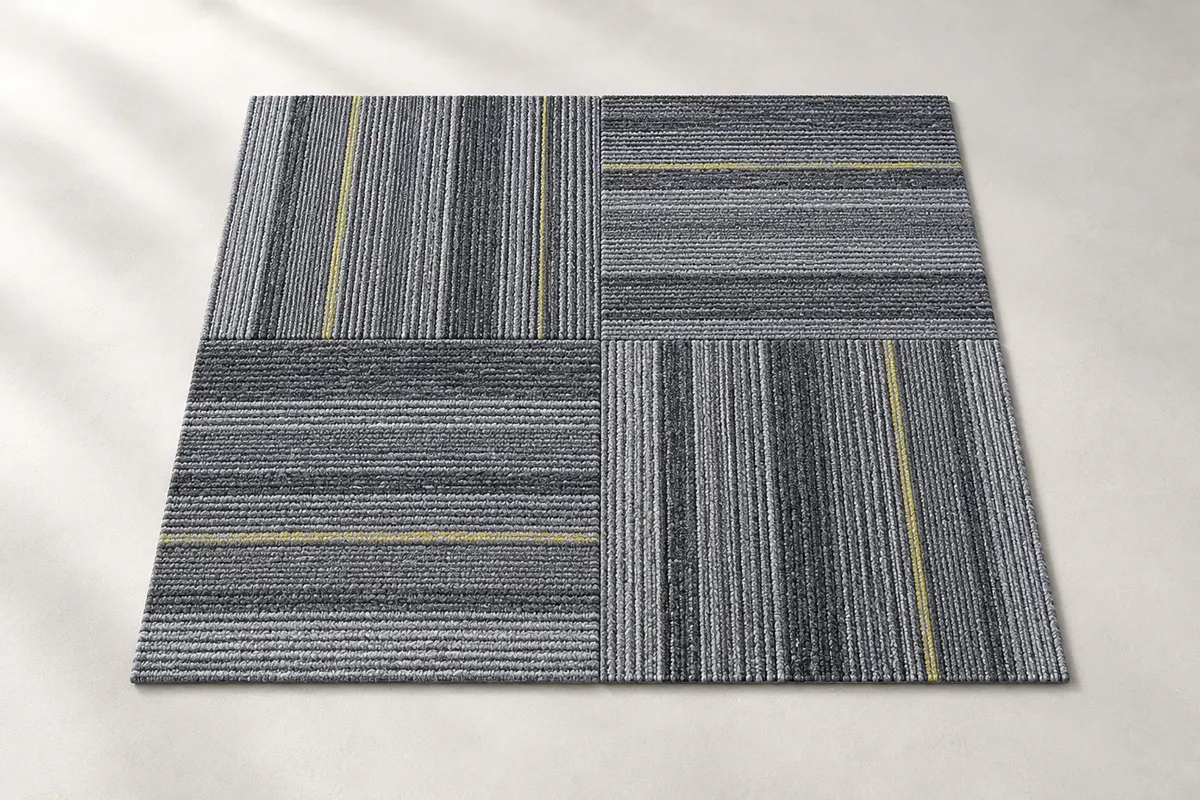
Commercial Carpet Tiles
Modular commercial carpet tiles for offices, hotels, corridors, education, and phased replacement programs.
View Category →
Product Category
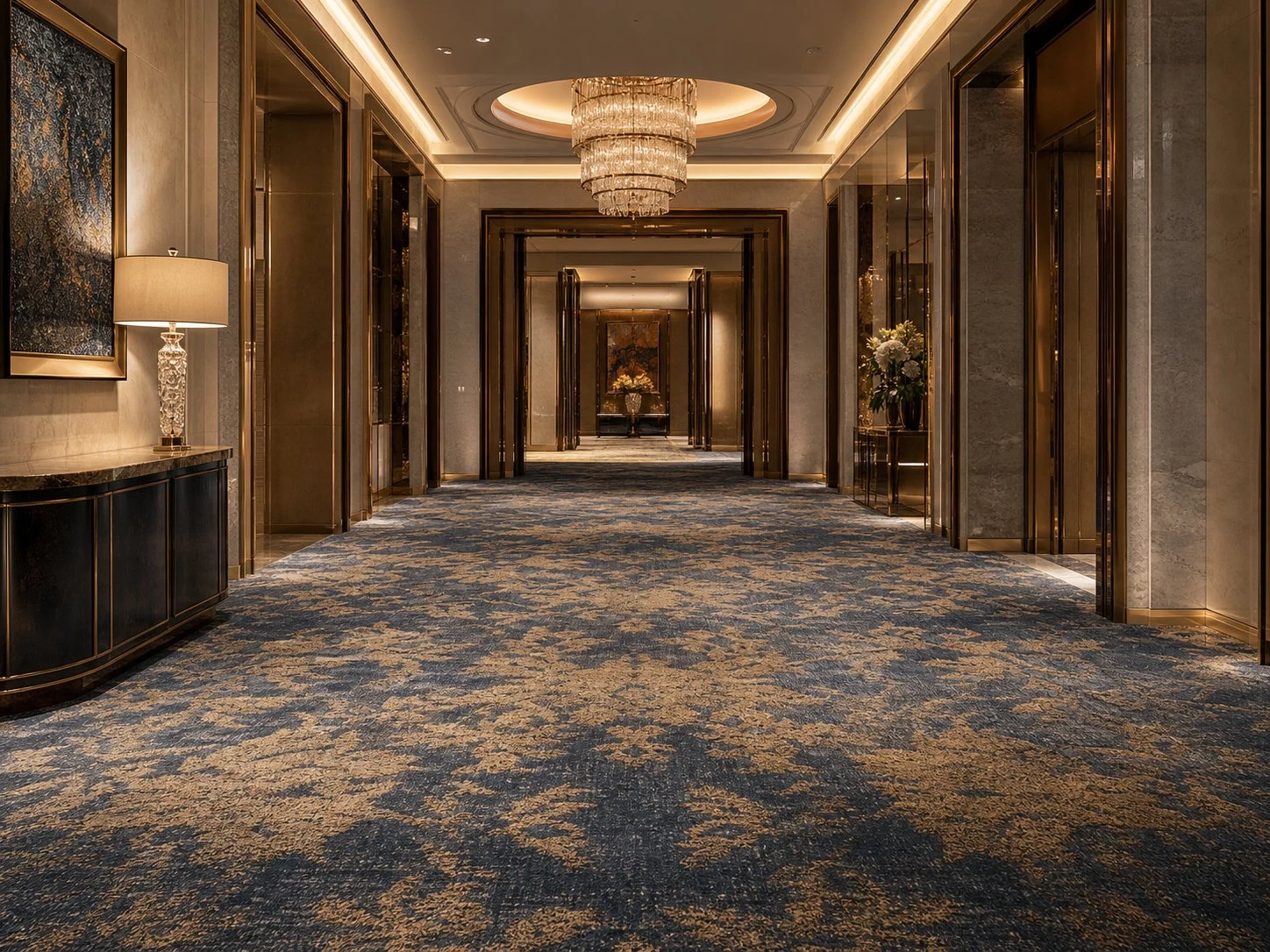
Wall-to-Wall Carpets
Custom broadloom carpet for guestrooms, corridors, lobbies, ballrooms, and branded hospitality interiors.
View Category →