
Commercial Carpet Warranty Claim Documentation Checklist
Build a traceable product, installation and maintenance record before requesting a technical review or remedy for a B2B carpet project.
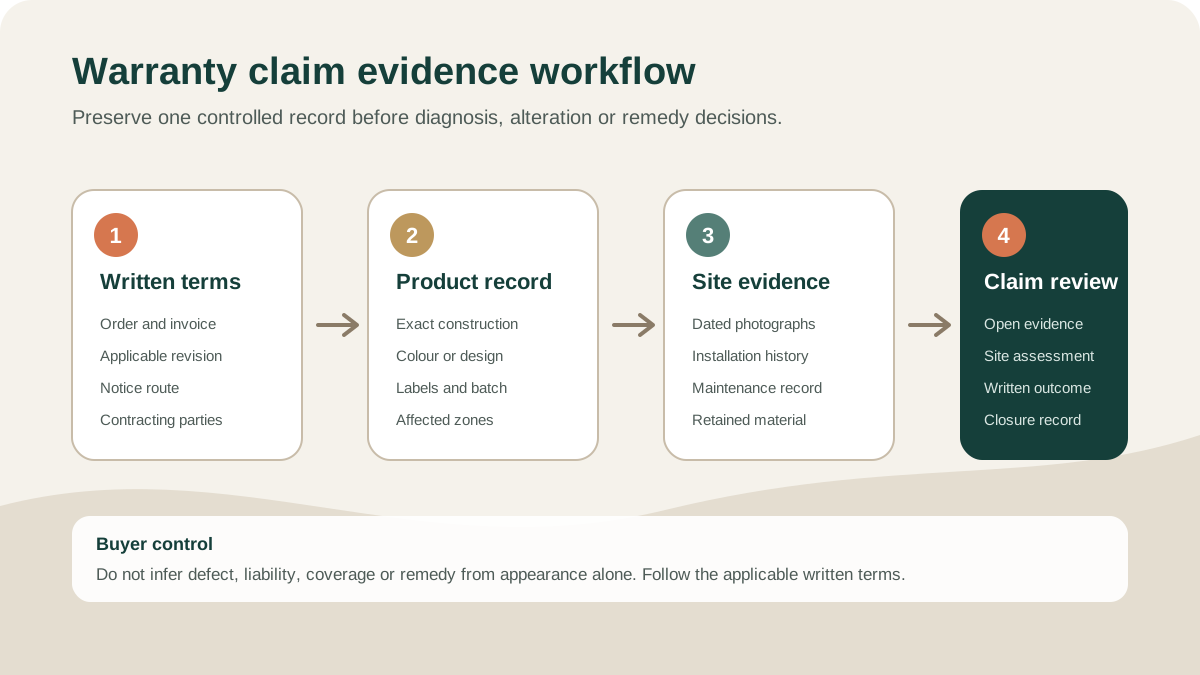
Pain Point Addressed
A buyer may report a serious carpet issue but still lack the exact product identity, affected-zone record, installation evidence, maintenance history and written terms needed for a useful review.
Quick Answer: Start With the Written Terms and Exact Product
A useful commercial carpet warranty claim starts with the written terms for the exact product and transaction. Identify the contracting parties, invoice or purchase order, product and colour or design, affected area and date first observed. Then preserve dated photographs, labels or batch references, delivery and installation records, maintenance history, incident details and the requested outcome.
Do not assume that a complaint, photograph or product-category description establishes a defect, cause, liability or remedy. Submit a neutral issue record through the notice route stated in the applicable terms and ask what material, documents or site access should be preserved for review.
Confirm Which Warranty or Commercial Record Applies
Commercial carpet warranties are not interchangeable. A document may be limited to a named product family, construction, country, invoice date, installation method or contracting entity. A competitor's published warranty can show the kinds of controls buyers should expect, but it cannot be transferred to another supplier or order.
| Control | Record | Question to resolve |
|---|---|---|
| Transaction | Accepted quotation, purchase order, invoice and amendments | Which legal parties and product were agreed? |
| Written terms | Applicable warranty or commercial terms and revision | Which scope, notice route and remedy language applies? |
| Product | Product name, construction, colour/design and available batch reference | Does the issue record identify the supplied construction? |
| Project | Delivery, installation, handover and zone records | Where and when was the material used? |
| Care | Product-matched maintenance instructions and service history | What was done, where, when and by whom? |
If the order documents and product labels disagree, record the discrepancy before assigning a cause. The buyer may need to clarify the contracting supplier, installer, maintenance provider, logistics party or project reviewer responsible for each part of the investigation.
Build One Evidence Pack Before Requesting a Decision
- Identify the order. Record the buyer, contracting supplier, order and invoice references, final product description and applicable written terms.
- Map the affected scope. Mark rooms, zones, tile positions, rolls or seam areas; separate affected and unaffected comparisons without assuming they have the same history.
- Create dated visual evidence. Use overview, mid-range and close-up photographs with location notes, scale where useful and consistent lighting where practical.
- Attach the project history. Include delivery, storage, substrate, installation, handover, cleaning, maintenance, incident and repair records that actually exist.
- Record every intervention. State what was cleaned, lifted, cut, moved, replaced or tested, by whom and why; preserve retained material when instructed.
- State the requested outcome. Ask for a technical review, inspection, document clarification, maintenance advice, repair proposal or coverage decision without assuming the result.
Describe the Observation Without Diagnosing It Remotely
Use observable language: loose fibres, granular residue, edge lifting, visible layer separation, seam opening, colour difference, staining, odour, movement or another defined condition. Add the affected location, approximate extent, first observation and whether it is changing. Avoid writing “manufacturing defect” as the observation when no assessment has established that conclusion.
| Useful entry | Why it helps | Avoid |
|---|---|---|
| Meeting room 3B, eight tiles near north doorway | Defines location and scale | Carpet is bad |
| Fine pale residue first photographed 17 October after routine vacuuming | Separates observation from cause | Backing is definitely failing |
| Edge lift visible on two named tiles; adjacent tiles photographed for comparison | Creates a controlled comparison | Whole batch is defective |
| Area protected and left unchanged pending written instructions | Preserves review options | We repaired it before notifying anyone |
For the separate question of loose fibres, residue or suspected layer separation, use the commercial carpet shedding and backing inspection guide before assigning a label.
Keep Installation and Maintenance Evidence Product-Specific
The Carpet and Rug Institute's commercial installation guidance treats substrate and site conditions as essential and warns that deviations can contribute to installation failure or affect manufacturer warranty treatment. Its commercial maintenance guidance likewise directs facilities teams to follow the carpet manufacturer's recommendations. These are general controls, not a finding about any VCARPETS product or project.
Keep the nominated installation instructions, substrate and site records, adhesive or fixing identity where relevant, installer details, handover date and maintenance plan. Record equipment, methods, products and dilution where known. Missing records should be listed as missing; they should not be reconstructed from memory as if verified.
Protect the Area and Preserve Material Before Rework
Protect people and operations first. If urgent action is needed, record the reason, date, persons involved, affected quantity, photographs and any material retained. Where practical, request written instructions before intensive cleaning, lifting tiles, cutting broadloom, replacing adhesive, discarding residue or sending samples.
If a supplier or inspector requests access, agree the visit scope, areas to remain available, documents to prepare, sampling authority and how findings will be recorded. A site visit is an evidence step; it is not automatic acceptance of coverage or responsibility.
The public Interface Southeast Asia carpet-tile warranty is one product- and market-specific example that requires a written claim and describes a representative site review. Its coverage, time limits and remedies do not apply to VCARPETS and are not reproduced as VCARPETS terms.
Use a Controlled Issue Log Until the Decision Is Closed
| Field | Example of a controlled entry | Decision value |
|---|---|---|
| Issue ID | CARPET-03 | Keeps photographs, samples and emails aligned |
| Location and quantity | Level 3 room 3B; eight named tiles | Defines the assessed scope |
| First notice | 29 October; sent through agreed route | Preserves the communication record |
| Evidence status | Product label and photographs received; maintenance log pending | Shows what is verified and missing |
| Next action | Supplier document review by named contact/date | Assigns ownership without promising outcome |
| Closure | Advice, inspection result, repair, replacement, commercial decision or no coverage | Records the actual resolution |
Keep the original issue notice and add dated revisions rather than silently replacing it. If the affected scope changes, record the reason and evidence. If the decision is contractual, technical or legal, retain the responsible party's written decision in the project file.
Copyable Commercial Carpet Issue Notice
For a new VCARPETS quotation, send the application, selected product or design, area, destination, required project date and the issue-reporting or document fields your buyer needs. VCARPETS can confirm available records for the quoted construction; final warranty and remedy terms must appear in the specific written transaction documents.
Request a product and issue-document review through the existing inquiry form. Include the project use, area, affected or replacement scope, destination and timing so the response can be matched to a real quotation.
Sources and Scope Boundaries
This checklist was informed by CRI 104 commercial installation guidance, CRI commercial maintenance guidance and one public Interface Southeast Asia carpet-tile warranty as a product-specific claim-route example. Sources were reviewed on 29 October 2026. No third-party warranty duration, threshold, exclusion, remedy, maintenance interval or installation requirement is transferred to VCARPETS.
This article is a B2B evidence and communication framework. It is not a warranty, legal opinion, defect diagnosis, inspection, coverage decision or promise of repair or replacement. The signed transaction documents, exact product records, applicable law and decisions of the responsible contracting and technical parties control the real project.
Commercial Carpet Warranty Claim FAQ
What should a commercial carpet warranty claim include?
Identify the contracting parties, invoice or order, exact carpet, affected zone and first observation. Attach dated overview and close-up photographs, installation and handover records, maintenance history, relevant labels or batch references, actions already taken and the outcome requested. Follow the notice method and timing in the applicable written terms.
Does a carpet photograph prove a manufacturing defect?
No. A photograph records appearance, not cause, responsibility or coverage. Product construction, site conditions, installation, maintenance, incidents and inspection findings may all be relevant. Describe the observation neutrally and preserve the affected material until the responsible party gives instructions.
Should damaged carpet be removed before the supplier reviews it?
Protect the area when safety or operations require it, but first request written instructions where practical. Removing, cleaning, cutting or discarding material can change the evidence. Record any urgent action, the reason, affected quantity and retained samples or photographs.
Are all commercial carpet warranties the same?
No. Coverage, duration, exclusions, notice periods, evidence and remedies depend on the written terms for the exact product, market and transaction. A competitor warranty, category page or general industry guide does not create coverage for a VCARPETS order.
What maintenance records should a carpet buyer keep?
Keep the product-matched maintenance instructions, service dates, affected zones, equipment and methods used, products and dilution where known, contractor details, incidents and corrective actions. The required records and their effect on coverage come from the applicable written terms.
What can VCARPETS review before a bulk order?
Send the intended application, product or design, area, destination, project schedule and required issue-reporting or document fields. VCARPETS can confirm the available product and commercial records for the specific quotation. Any warranty or remedy must be stated in the final written transaction documents.
Buyer Questions
Frequently Asked Questions
What should a commercial carpet warranty claim include?
Identify the contracting parties, invoice or order, exact carpet, affected zone and first observation. Attach dated overview and close-up photographs, installation and handover records, maintenance history, relevant labels or batch references, actions already taken and the outcome requested. Follow the notice method and timing in the applicable written terms.
Does a carpet photograph prove a manufacturing defect?
No. A photograph records appearance, not cause, responsibility or coverage. Product construction, site conditions, installation, maintenance, incidents and inspection findings may all be relevant. Describe the observation neutrally and preserve the affected material until the responsible party gives instructions.
Should damaged carpet be removed before the supplier reviews it?
Protect the area when safety or operations require it, but first request written instructions where practical. Removing, cleaning, cutting or discarding material can change the evidence. Record any urgent action, the reason, affected quantity and retained samples or photographs.
Are all commercial carpet warranties the same?
No. Coverage, duration, exclusions, notice periods, evidence and remedies depend on the written terms for the exact product, market and transaction. A competitor warranty, category page or general industry guide does not create coverage for a VCARPETS order.
What maintenance records should a carpet buyer keep?
Keep the product-matched maintenance instructions, service dates, affected zones, equipment and methods used, products and dilution where known, contractor details, incidents and corrective actions. The required records and their effect on coverage come from the applicable written terms.
What can VCARPETS review before a bulk order?
Send the intended application, product or design, area, destination, project schedule and required issue-reporting or document fields. VCARPETS can confirm the available product and commercial records for the specific quotation. Any warranty or remedy must be stated in the final written transaction documents.
Turn This Guide Into a Quote
Send Your Project Requirements After Reading This Guide
If this topic matches your project, send the carpet application, estimated area, destination, and required date. VCARPETS can recommend the related product path and reply with sample, MOQ, lead time, and quotation details.
Email: sales@vcarpets.com
Continue Your Specification
Related Products


Browse the Full Range
Related Product Categories
Product Category
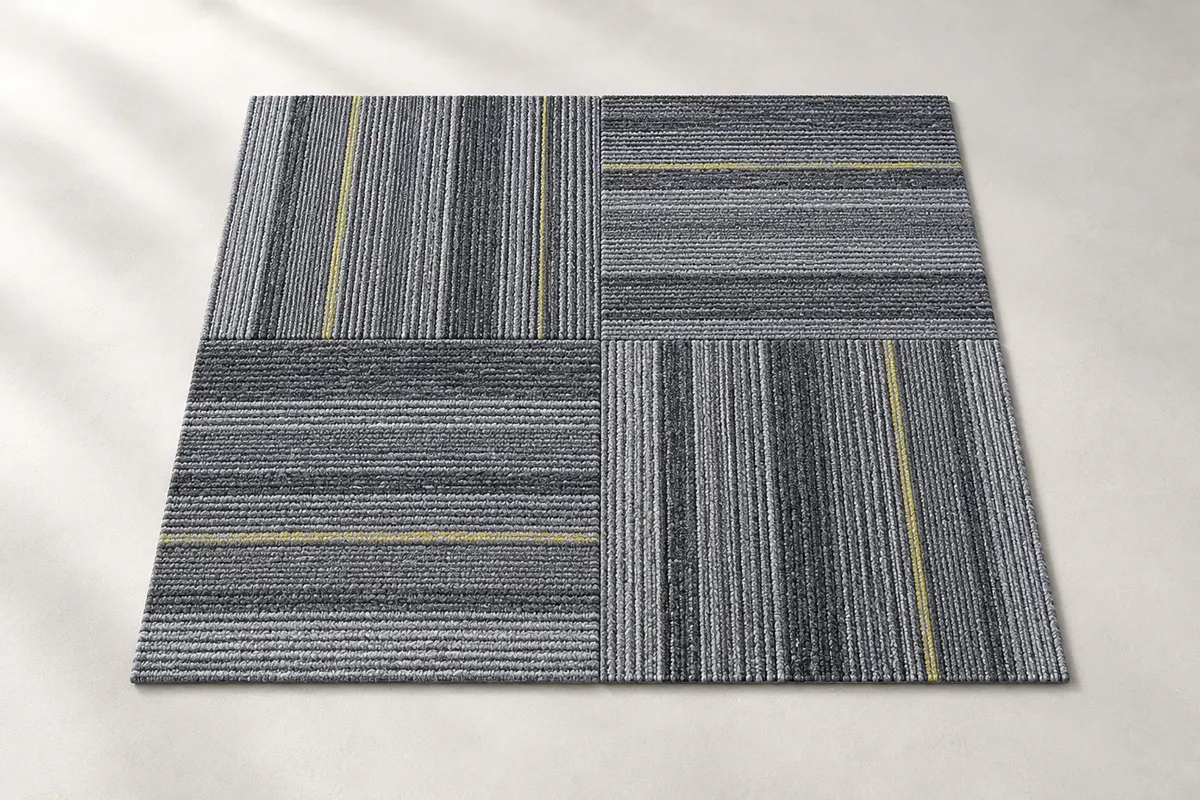
Commercial Carpet Tiles
Modular commercial carpet tiles for offices, hotels, corridors, education, and phased replacement programs.
View Category →
Product Category
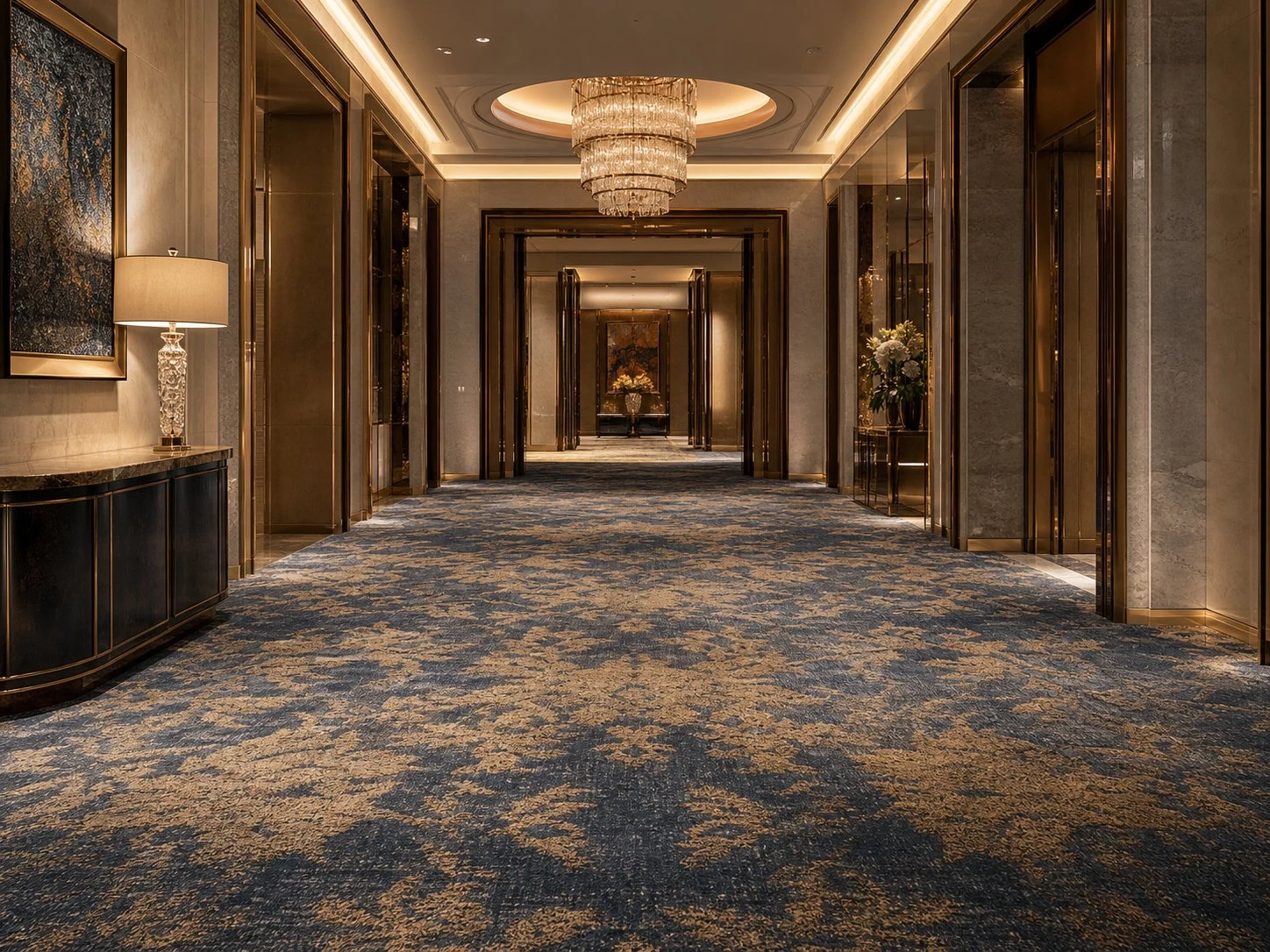
Wall-to-Wall Carpets
Custom broadloom carpet for guestrooms, corridors, lobbies, ballrooms, and branded hospitality interiors.
View Category →