
Commercial Carpet Tile Replenishment: Dye Lots, Spare Stock and Replacement
Record the original product and batch, reserve identified spare tiles, and compare replacements with the installed floor before reordering. Agree reserve quantities by project risk, not a universal percentage; confirm availability, compatibility and appearance before approval.
Pain Point Addressed
Plan commercial carpet tile replenishment with dye-lot records, spare-stock allocation and replacement review. A practical guide for B2B flooring buyers.
How should commercial carpet tile replenishment be planned?
Record the installed product and batch, reserve identified spare tiles, and review replacement samples against the existing floor before ordering. Set reserve quantities by project risk and replacement area, not a universal percentage. Confirm availability, compatibility and appearance in writing before releasing a replenishment order.
This guide addresses post-installation stock control and reordering. It does not replace product-specific installation or maintenance instructions. For arrival checks before initial installation, use the separate delivery inspection guide.
What does a dye-lot reference tell the buyer?
A dye lot or production reference helps identify material from a particular run. Record the wording printed on the supplied carton or tile; product name and colour name alone may not identify the batch. If a field is missing, request confirmation rather than creating a batch number.
A matching reference does not by itself guarantee that stored replacement tiles will look identical to a floor that has been used, cleaned or exposed to light. Conversely, some manufacturers offer specific ranges designed for mixing lots. Do not assume that a feature of another brand or range applies to the selected VCARPETS product.
| Replacement source | What to check | Approval boundary |
|---|---|---|
| Retained stock from the original order | Readable batch labels, remaining quantity, storage condition and installed zone | Review condition and appearance; original-order identity is not a promise of invisible replacement. |
| A later order of the same product and colour | Current construction, dimensions, backing, batch reference and current sample | Do not approve by product name or screen colour alone. |
| An alternative or discontinued-product substitute | Physical fit, backing/fixing compatibility, appearance and proposed replacement area | Treat as a new selection and seek the project team’s approval before purchase. |
How much spare carpet tile stock should a project retain?
Separate installation allowance from maintenance reserve. Cutting allowance is consumed during fitting; reserve stock must still be available after handover. Ask the installer to confirm the planned cutting and layout needs, then ask the facilities team to define the replacement area and service risks it wants to cover.
- Assess the zones. Identify entrances, circulation routes, chair areas and other locations where the project expects localized replacement. Do not convert an assumption into a guaranteed failure rate.
- Check supply continuity. Ask whether the specific design and construction are current, whether later runs can be compared, and what happens if the range changes. A current listing is not a future availability promise.
- Convert area to the confirmed packing unit. Use the actual tile dimensions and tiles-per-carton on the current quotation, not a carton count copied from another model.
- Agree the budget and storage owner. Record who approves the reserve, where it will be kept and who can release it.
Illustrative calculation only: if a hypothetical tile measures 0.50 m × 0.50 m, each tile covers 0.25 m². A buyer-approved reserve area of 12 m² would therefore equal 48 tiles before rounding to the confirmed carton quantity. The 12 m² is a planning input, not a recommended allowance or a VCARPETS specification.

Which records should stay with the spare tiles?
Keep one controlled record linking the retained stock to the physical floor. A small sample and a carton label are useful only if the next facilities team can identify where the material belongs. Keep the original label photographs alongside the purchasing record, not only in an employee’s private message history.
| Record field | What to retain |
|---|---|
| Product identity | Supplier, product/design code, colour, dimensions and quoted backing/construction |
| Order and batch | Purchase-order reference, delivery date and exact carton or tile batch wording |
| Installed location | Building, floor, room/zone and the approved layout or orientation reference |
| Reserve inventory | Opening tile/carton count, storage location, withdrawals and remaining count |
| Appearance reference | Identified retained sample and dated location photographs under recorded lighting |
| Decision ownership | Person who can approve a replacement, reorder or alternative product |
The carpet tile category provides a batch, zone and spare record that can be adapted to the project. Keep quantities and dates current whenever tiles are removed from reserve.

How should a replacement be reviewed on the existing floor?
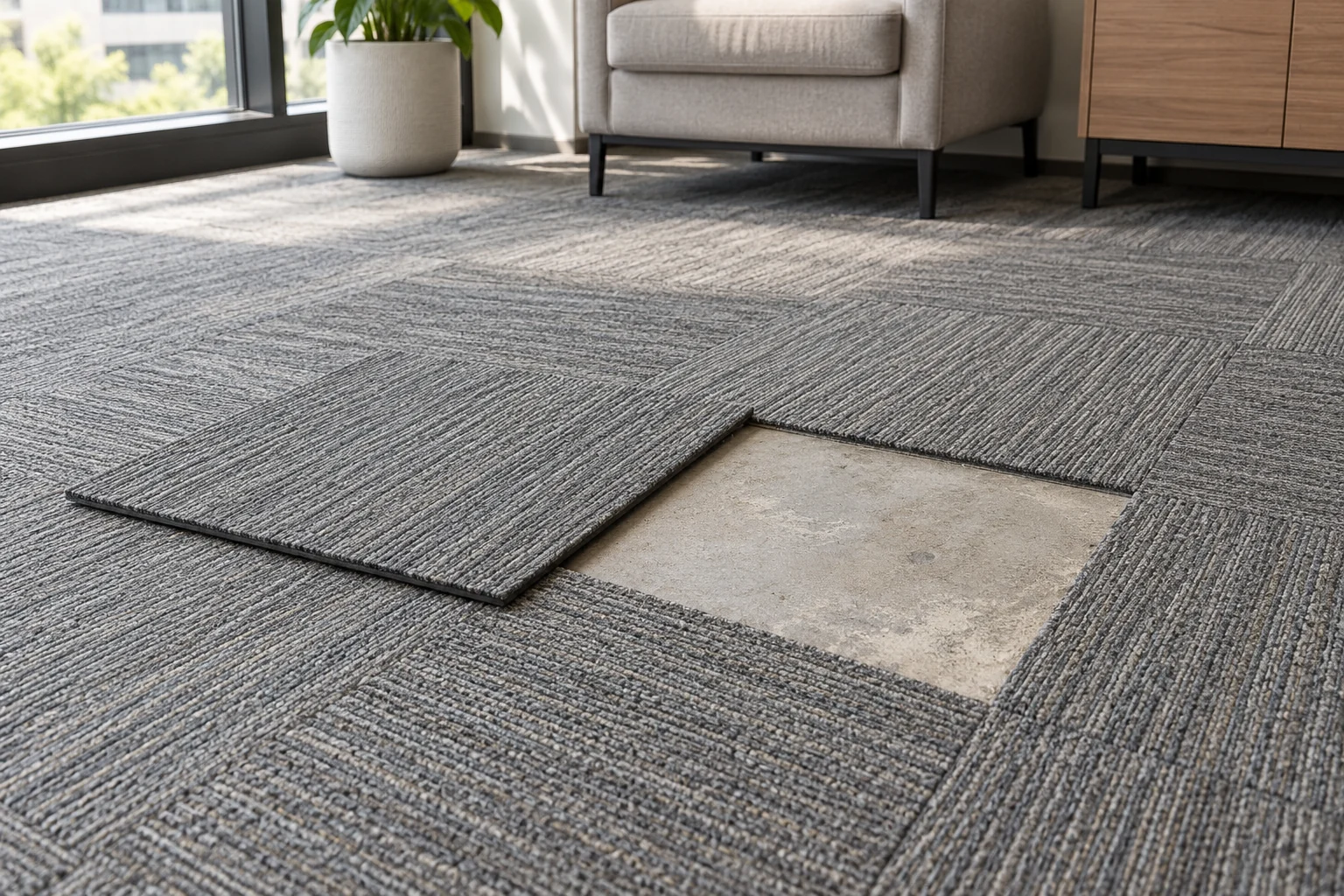
First check whether the issue needs cleaning, investigation or replacement under the product’s maintenance instructions. Where replacement is appropriate, the installer should check the fixing system and substrate condition before removal. Do not treat a general photograph or this guide as approval for a particular adhesive or removal method.
- Identify the floor. Match the location to the original product, batch, layout and fixing records.
- Compare representative material. Review the candidate tile near the affected area under the normal site lighting. Check pile direction, texture, edge fit, height and the overall visual field.
- Choose the replacement boundary. If an isolated tile is conspicuous, ask the project team whether a defined zone or another documented approach is acceptable. Do not silently mix batches across the floor.
- Approve and record. Document the chosen product, source stock, quantity, location, approver and date, then update the reserve balance.
New stock can look newer than surrounding used tiles. Interface’s published maintenance guidance describes this appearance issue for its products. It supports reviewing the physical result rather than promising that every replacement will disappear visually; its brand-specific installation methods must not be applied automatically to other products.
What should a replenishment inquiry include?
Send the original order or product reference, clear carton-label photographs, current floor photographs, the affected zone, remaining reserve quantity, required replacement area and project location. Include any confirmed tile dimensions, backing and fixing information, plus the date the site needs a decision. Mark unknown fields explicitly.
Ask VCARPETS to confirm the proposed product identity, sample-review route, packing quantity, current supply conditions and quotation basis. Do not rely on an old price, historical MOQ or a promise that another batch will be identical. Bulk commercial terms and project-specific requirements should be confirmed in the written quotation.
If the floor needs a broader redesign rather than replacement, use the office carpet tile layout approval guide and review the new layout separately.
Sources and planning limits
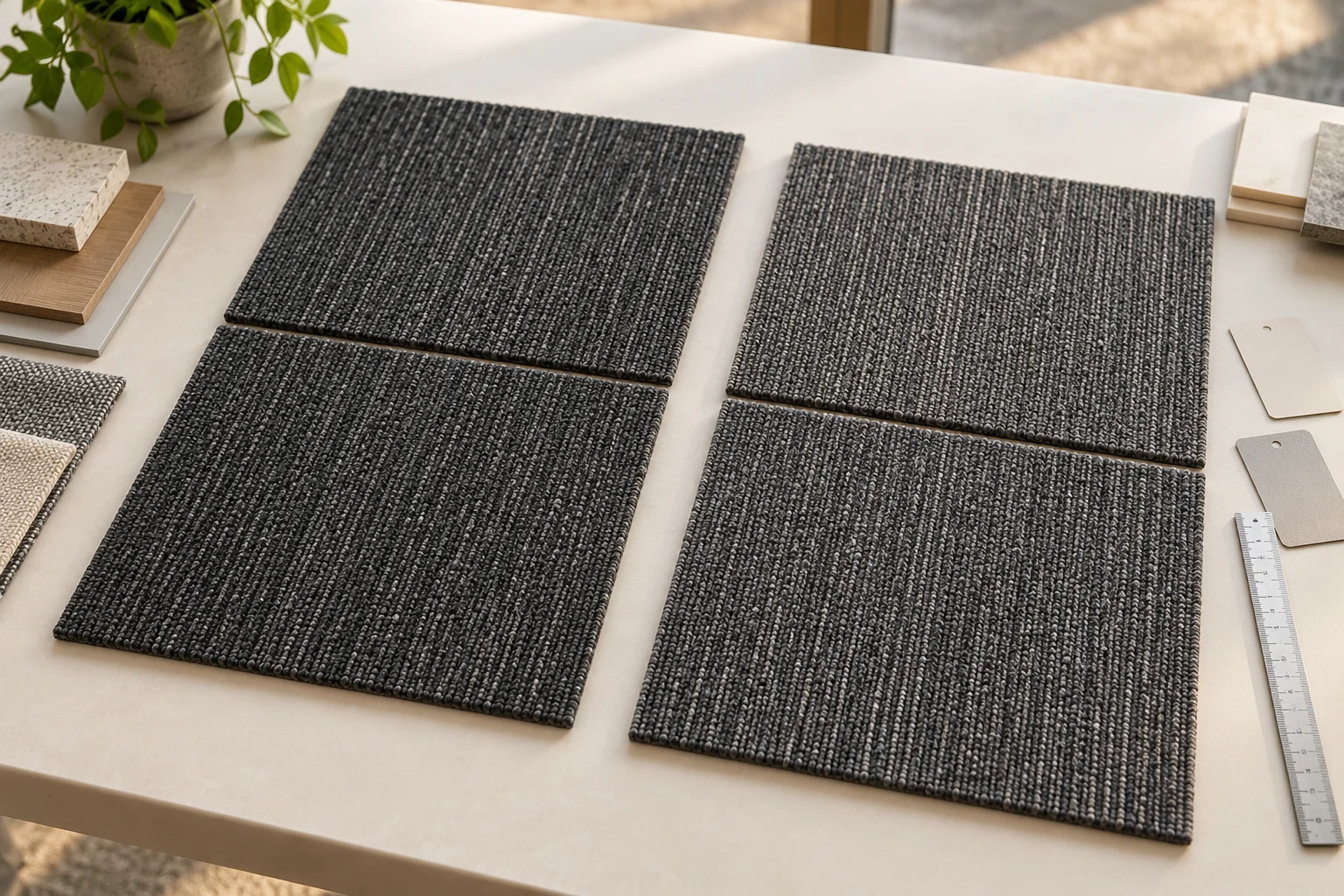
This is a procurement planning guide from VCARPETS, operated by Tianjin Vcarpets Global Commercial Carpet Co., Ltd. The four images are generated planning illustrations, not product evidence, inspection records or completed client projects.
The external references below are manufacturer guidance for their own products. Interface’s maintenance guide discusses retained stock and the newer appearance of replacement tiles; its CushionBac Renew instructions illustrate product, colour, run and dye-lot label records. These sources do not establish VCARPETS performance, compatibility or stock availability. Confirm the current instructions for the exact product purchased.
Buyer Questions
Frequently Asked Questions
Can I reorder commercial carpet tiles using only the colour name?
A colour name is not enough to confirm a replacement. Provide the product or design code, original order, batch-label photographs, dimensions and backing information where available. Review a current sample against the installed floor before approval.
How many spare carpet tiles should an office project keep?
There is no single allowance suitable for every office. Agree the reserve by expected replacement area, zone exposure, supply continuity, storage and budget. Keep installation cutting allowance separate, then convert the approved reserve into the confirmed tile and carton quantities.
Will spare tiles from the original batch match an older floor exactly?
Not necessarily. Retained tiles and a used floor may look different because their use, cleaning, exposure and storage histories differ. Compare representative material under the site lighting and approve the visible result before installation.
Can carpet tiles from different dye lots be mixed during replacement?
Only follow the instructions and approval for the exact selected product and layout. Some specific ranges permit mixing, but that feature must not be assumed for another product. Keep labels traceable and obtain a documented visual review.
What can a buyer do if the original carpet tile is discontinued?
Ask the supplier to confirm any remaining stock and compare a proposed alternative for size, construction, backing, fixing and appearance. The project team may need to approve a defined replacement zone or a broader change rather than an isolated tile.
What should be included in a VCARPETS replenishment quotation request?
Send the product/order reference, carton labels, floor photographs, required area, remaining spares, destination and project date. Include known dimensions, backing and fixing details. Request written confirmation of the offered product, sample process, packing and commercial conditions.
Turn This Guide Into a Quote
Send Your Project Requirements After Reading This Guide
If this topic matches your project, send the carpet application, estimated area, destination, and required date. VCARPETS can recommend the related product path and reply with sample, MOQ, lead time, and quotation details.
Email: sales@vcarpets.com
Continue Your Specification