
Commercial Carpet Sample Approval Checklist for Project Buyers
Identify what the physical sample represents, record exactly what is approved, and keep outstanding technical or commercial decisions visible before a bulk order.

Pain Point Addressed
A sample can look correct while the quoted construction, installation direction, batch plan or supporting documents remain unclear. That creates avoidable approval and replacement risk after production.
Quick Answer: Approve a Defined Reference, Not an Unqualified 'OK'
Before approving a commercial carpet sample, identify its origin, the quoted product and construction, and the decision being made. Record colour, pattern, texture and layout separately from technical-document acceptance and bulk-order release. A useful sign-off names the reference, revision, reviewer and open conditions; an attractive swatch alone does not establish that the proposed order is ready.
This checklist is for importers, distributors, contractors and project buyers comparing office tiles, hotel broadloom or custom entertainment-venue carpet. Use it to reduce ambiguous approvals and prepare a supplier discussion. It is a purchasing workflow, not a test method, an inspection certificate or a promise that a later production lot will match an earlier sample.
Material, Colour and Pattern Samples Approve Different Things
Before paying for a sample, agree the decision it will support. A material swatch, colour reference and custom printed pattern sample may represent different approval stages. A sample request does not establish that a format is in stock or that every construction is available. VCARPETS confirms the suitable sample type, fees, courier charges and preparation time per project.
| Review purpose | What to examine | What remains separate |
|---|---|---|
| Material review | Quoted fibre, pile, texture and the actual nominated backing | Custom artwork, full repeat and applicable test evidence |
| Colour review | Reference colour under representative venue lighting | Full-floor appearance, construction and batch acceptance |
| Custom pattern review | Artwork revision, motif scale, repeat and direction | Final layout, joins, order quantity and product document acceptance |
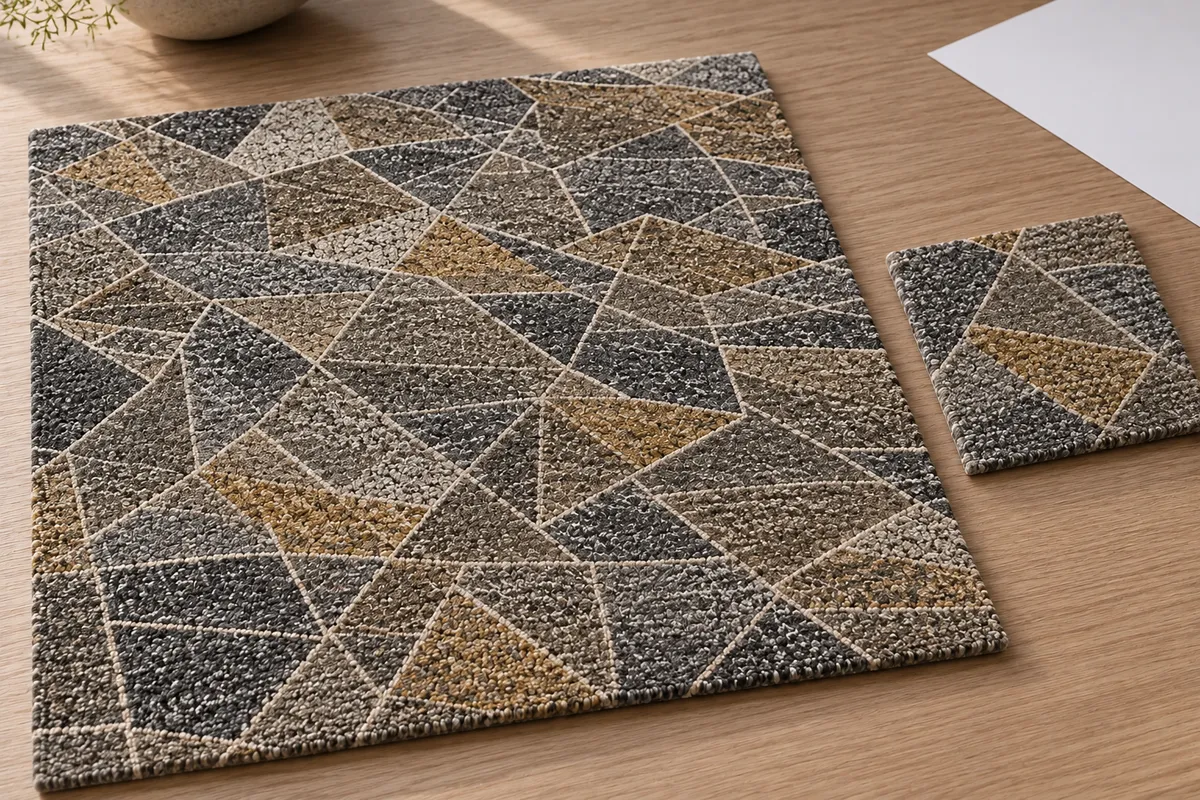
Can a small colour sample approve a cinema floor design?
It can help review colour and texture, but may show only part of a motif. Request the artwork repeat in both directions and review how the pattern reads on the venue plan. Agree whether a larger pattern sample is needed before production. Digital renderings support discussion; retain a physical reference tied to the written construction and artwork revision.
- Identify the reference. Record sample identifier, quotation revision, fibre, backing, artwork version and the review date.
- Separate approval decisions. State whether approval covers material, colour, pattern or all three; identify documents or details still open.
- Control changes. Re-review a changed construction, colour or artwork rather than carrying forward an unrelated earlier approval.
- Prepare the request. Send venue use, area, destination, design reference, approval purpose and target review date. Paid Philippine sample requests are accepted; format, fees and timing are confirmed per project.
Does an approved sample prove fire performance?
No. Product and assembly reports must match the nominated construction and be reviewed against the project's actual requirements. A reference public tender separately asks for product data, colour/pattern samples, installation instructions and maintenance information. Keep these as distinct approval records rather than treating a decorative sample as a certificate.
Answer First: Approval Must Cover More Than Colour
A commercial carpet sample approval should record the physical material, exact product construction, colour and pattern direction, pile appearance, backing, installation method, document status and batch assumptions. A screen image or small colour swatch can start the conversation, but it should not be treated as final approval when the project depends on repeatable material and a controlled installation result.
| Approval item | What to inspect | Record before sign-off |
|---|---|---|
| Colour and pattern | Colour under representative lighting, pattern scale, repeat, tonal balance and direction | Approved sample reference, lighting context, pattern direction and approver |
| Pile and surface | Visible texture, yarn appearance, pile direction and adjoining-face appearance | Exact construction and pile description; performance needs separate evidence |
| Backing and thickness | Edge, cross-section, backing build-up and dimensional feel | Backing type, total thickness, tile or broadloom format and document reference |
| Installation | Direction, layout, seam or tile placement and subfloor assumptions | Installation drawing or written layout, adhesive route and site checks |
| Batch and replacement | Colour consistency, spare material and future replacement logic | Batch or dye-lot approach, spare quantity, carton labels and storage plan |
Final approval should refer to the nominated construction and written project records, not only to an image of the sample.
Establish Sample Origin Before Judging the Result
Two similar-looking samples may answer different questions. Ask where each piece came from and what it is intended to represent. A library swatch may support initial selection; a custom development sample may show a proposed colour or pattern; a piece identified to an actual production lot may support review of that lot. The supplier should confirm the relationship rather than leaving the buyer to infer it from a label or photograph.
| Reference offered | Useful question | Do not assume |
|---|---|---|
| Library or stock swatch | Which current construction and colour does this represent? | That the bulk lot is reserved, available or already approved |
| Custom development sample | Does this show the nominated artwork and construction revision? | That the whole repeat, production route or final order is covered |
| Full tile or multi-tile arrangement | Which direction, adjoining edges and visual range were reviewed? | That every layout is permitted or that visual review proves performance |
| Production-identified piece | Which lot, date and order does it represent, and how was it selected? | That one piece verifies all packed material or replaces an agreed inspection plan |
These are review purposes, not a list of sample formats guaranteed to be available. Agree the format and representativeness for the actual product.
Keep both the supplier's identifier and your own project reference on the record. Include the quotation revision, fibre, backing, nominal format, colour or artwork revision, sample origin, receipt date and reviewer. If a label is incomplete, resolve the missing information before calling the sample a control reference. A photograph can preserve the label and arrangement, while the physical piece remains necessary for a material or colour comparison.
Where the design intentionally varies, ask whether the review needs several pieces or a range display. Agree what that display represents and how subsequent material will be compared. There is no universal number of samples, shade tolerance or acceptance percentage in this checklist. The buyer, supplier and relevant project reviewer must agree a suitable scope; a photograph or a single preferred piece cannot define an unrecorded range.
The Five-Step Commercial Carpet Sample Approval Sequence
- Define the approval owner Name the designer, consultant, contractor, owner or facilities representative who can approve colour, construction and installation direction.
- Review the physical sample Check the material under the project lighting and against the intended furniture, wall finish, entrance condition and adjacent floor.
- Match the sample to the quotation Confirm that the sample reference matches fiber, pile, backing, size, thickness, pattern, quantity and quotation assumptions.
- Review technical and installation records Connect the sample to available fire, VOC, maintenance, adhesive, subfloor and installation documents for the exact construction.
- Issue a traceable approval Record approval date, sample reference, changes, pattern direction, batch assumptions, spare stock and any conditions before production.
Colour, Pattern and Lighting Checks
Carpet can change appearance with pile direction, viewing angle, daylight, artificial lighting and surrounding finishes. For a hotel corridor, school entrance, office workstation or public area, check the sample in the context where the material will be used. If the project has a repeat, printed artwork, woven pattern or directional installation, the approval record should make that direction visible to production and installation teams.

Backing, Installation Direction and Batch Control
| Risk | Why it appears after approval | Preventive record |
|---|---|---|
| Backing mismatch | The visible sample was approved without identifying the quoted backing system. | Construction sheet, backing reference, total thickness and installation recommendation |
| Direction mismatch | The layout drawing or installation convention was not attached to the sample approval. | Arrow, ashlar, quarter-turn, monolithic or broadloom seam direction |
| Batch variation | Spare material or later phases were ordered without a colour and batch plan. | Approved batch, spare cartons, storage conditions and future replacement note |
| Document gap | A general claim was accepted instead of the document for the nominated construction. | Fire, VOC, maintenance, adhesive and subfloor document checklist |

Record Partial Approval and Keep the Release Decision Separate
A designer may approve the colour while a consultant is still reviewing documents and an installer is checking the fixing system. Record those decisions separately. Otherwise, a forwarded message saying 'sample approved' can be interpreted as permission to make or ship the full order even though the parties intended only a visual selection.
| Decision | Record the result | Keep open until confirmed |
|---|---|---|
| Appearance | Reference, lighting, viewing direction, colour/pattern and reviewer | Any unresolved motif scale, variation or adjoining-tile review |
| Construction | Nominated fibre, backing, format and product-sheet revision | Any difference between the physical reference and quoted configuration |
| Documents and installation | Required records, their construction scope and named reviewer | Missing evidence, fixing compatibility and project-specific site checks |
| Commercial release | Approved order revision, quantity, terms and authorized decision-maker | Sample cost/timing, packing, production schedule and other unresolved conditions |
Use explicit statuses such as selected for further review, appearance accepted, revise and resubmit, or released against the named order revision. The parties should agree what each status permits. A condition should state the unresolved item, responsible person and next decision date. Do not treat silence or a courier delivery receipt as approval.
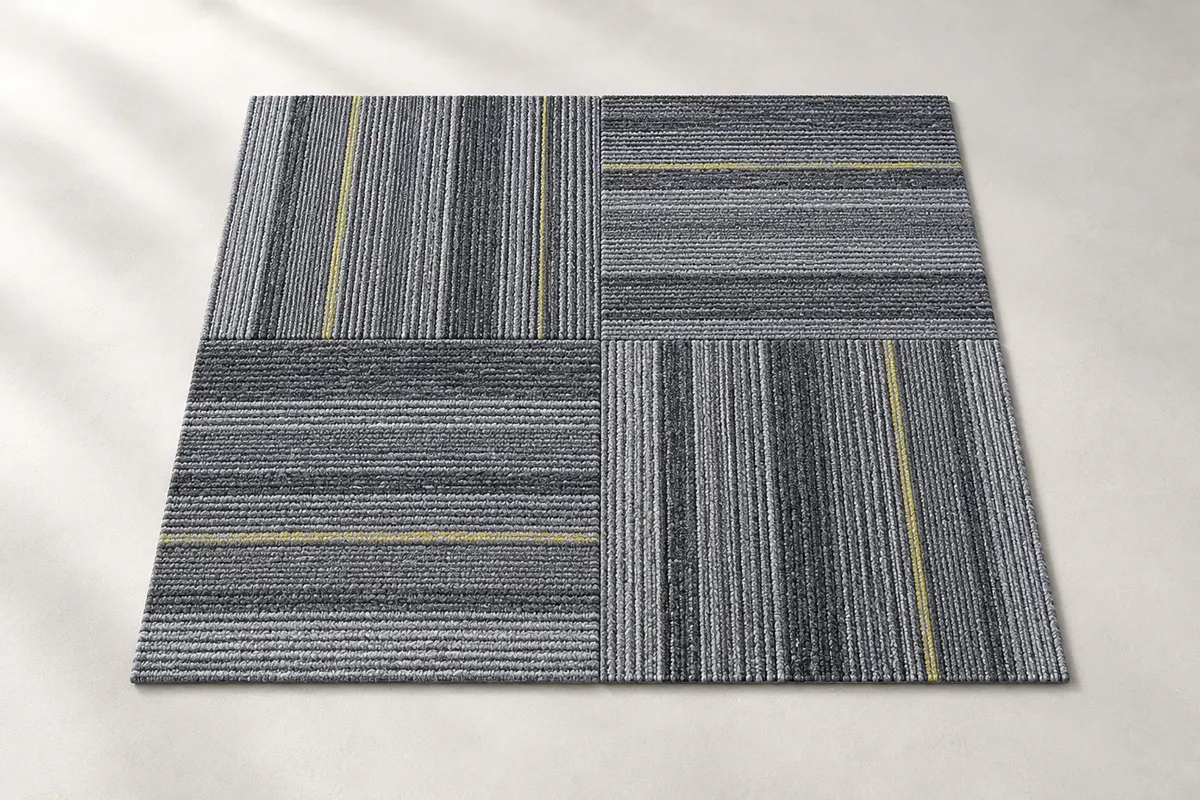
For example, an office buyer might shortlist the PP PVC-backed office carpet tiles from a striped image. The team then reviews identified physical tiles and records the chosen arrangement. If the quotation later names a different backing, keep the earlier appearance decision but reopen construction, fixing and document review. This hypothetical sequence does not establish equivalence, product-specific installation approval or a delivered VCARPETS project.
Use the office carpet tile layout approval guide for direction, boundaries and drawing revisions. For a cinema or patterned broadloom request, connect the material reference to pattern repeat and seam planning. These linked decisions belong in one order record, but approval of one should not silently approve the others.
Keep a Retained Reference and Control Later Changes
Agree who retains the physical approval piece and how the buyer and supplier will identify corresponding references. Record whether the retained piece is a selection swatch, development sample or production-identified sample. Store and handle it according to applicable instructions so damage, contamination or fading does not make a later comparison misleading. Digital photographs support traceability but do not preserve exact colour or texture.
If artwork, fibre, backing, size or the nominated colour changes, issue a new revision and identify the approvals that need reopening. Keep superseded records clearly marked rather than deleting the decision history. Ask whether the change affects documents, quantity, price, sample preparation or production timing before releasing it. Approval of a sample does not by itself reserve a future batch or guarantee an arrival date.
For phased installations, link the approved reference to the delivered lot and installation zone wherever those identifiers are provided. Keep installation allowance and retained replacement stock separate in the order. At receiving, reconcile the labels and quantities with the agreed records before allocation; use the batch, zone and spare receiving record already provided on the carpet tile collection page. Later replacement material may require a new appearance review against the existing floor.
Sample Approval RFQ Fields
- Project and zone Building type, room or zone, location, area and installation phase.
- Sample request Product reference, review purpose, requested format, origin or representativeness, colour/artwork reference and target approval date.
- Technical review Fiber, pile, backing, tile or broadloom format, thickness, fire or VOC document needs and maintenance route.
- Installation review Subfloor, adhesive, direction, seam or tile layout, furniture movement and site access conditions.
- Commercial review Area/quantity, separate allowances and spares, destination, target receiving date, sample fees/courier/timing and bulk FOB Tianjin Port quotation.

Request sample approval support with the project use, approximate area, product reference, destination and target review date. Say what the sample must help you decide, and which construction or document questions remain open. The current form has no drawing-upload field; summarize the brief there and arrange file transfer through the existing sales discussion. Sample type, fees, courier and preparation time are confirmed per project. Bulk quotations are FOB Tianjin Port; sample dispatch is a separate arrangement.
For overseas project purchasing, use the FOB Tianjin Port buyer checklist to distinguish sample approval, production readiness and the wider receiving schedule. Philippine B2B inquiries and paid sample discussions are accepted; format, cost and timing still require confirmation for the selected product and destination.
Copyable Sample Request and Approval Record
Please review our commercial carpet sample requirement. Our project brief identifies the intended use, area, destination and review deadline. Please confirm what the proposed sample represents, its nominated construction and artwork revision, available supporting documents, and the sample format, charges and timing. Keep alternatives separate and identify any decision the sample cannot support.
- Identify: Project/zone; product and quotation revision; supplier sample ID; buyer reference; sample origin and receipt date.
- Define: Review purpose; fibre/backing/format; colour or artwork revision; layout and representative viewing conditions.
- Decide: Accepted items; rejected or revised items; open documents or installation questions; named reviewer and date.
- Release: What the status authorizes; final order revision and decision-maker; change-control and retained-reference arrangements.
This is a blank purchasing framework, not a request to invent missing values. Mark unresolved information as pending in your internal record, assign responsibility and ask for clarification. The public product page, identified sample, nominated product sheet and written quotation should describe the same selected configuration before the buyer treats it as approved.
Primary Procurement References and Their Limits
UFGS 09 68 00 separates carpet samples from product data, installation drawings and other submittals. The public Missouri R2321-01 tender likewise treats product data, carpet tile colour/pattern samples and installation information separately; its general submittal section also addresses sample identification and visual variation. These are examples of buyer documentation needs, not VCARPETS certifications, universal sample quantities or requirements for every country.
References reviewed 16 October 2026: UFGS 09 68 00, November 2024 edition with references aligned to July 2026, and Missouri Office of Administration R2321-01 Final Specifications, sections 013300 and 096813. The recommendations and blank record above are a practical synthesis. Use the actual project's requirements and selected product evidence for acceptance, tolerances, performance and installation decisions. Source links are provided in the related resources below.
Frequently Asked Questions
Does accepting the colour sample approve the bulk order?
No. Record exactly which appearance decisions are accepted and which construction, document, layout or commercial decisions remain open. Bulk release should refer to the approved order revision and authorized decision-maker.
How many carpet samples should we request?
There is no universal quantity in this checklist. Agree a format and number that answer the review question, such as colour selection, a full pattern repeat or adjoining-tile appearance. Confirm availability, fees and timing with the supplier.
Does a production-identified sample verify every carton?
No. Record which lot and order it represents and how it was selected. A single piece does not replace the inspection scope and acceptance rules agreed for the actual order.
Can we approve fire, VOC or traffic performance by looking at a sample?
No. Visual and tactile review does not establish those results. Request applicable documents for the exact nominated construction and have the relevant project reviewer assess them.
What should we send VCARPETS for a sample discussion?
Send the project use, approximate area, selected product or design reference, review purpose, destination and target review date. Sample format, charges, courier and timing are project-specific; bulk quotations are FOB Tianjin Port.
Buyer Questions
Frequently Asked Questions
Does accepting the colour sample approve the bulk order?
No. Record exactly which appearance decisions are accepted and which construction, document, layout or commercial decisions remain open. Bulk release should refer to the approved order revision and authorized decision-maker.
How many carpet samples should we request?
There is no universal quantity in this checklist. Agree a format and number that answer the review question, such as colour selection, a full pattern repeat or adjoining-tile appearance. Confirm availability, fees and timing with the supplier.
Does a production-identified sample verify every carton?
No. Record which lot and order it represents and how it was selected. A single piece does not replace the inspection scope and acceptance rules agreed for the actual order.
Can we approve fire, VOC or traffic performance by looking at a sample?
No. Visual and tactile review does not establish those results. Request applicable documents for the exact nominated construction and have the relevant project reviewer assess them.
What should we send VCARPETS for a sample discussion?
Send the project use, approximate area, selected product or design reference, review purpose, destination and target review date. Sample format, charges, courier and timing are project-specific; bulk quotations are FOB Tianjin Port.
Turn This Guide Into a Quote
Send Your Project Requirements After Reading This Guide
If this topic matches your project, send the carpet application, estimated area, destination, and required date. VCARPETS can recommend the related product path and reply with sample, MOQ, lead time, and quotation details.
Email: sales@vcarpets.com
Continue Your Specification
Related Products

Browse the Full Range
Related Product Categories
Product Category
Commercial Carpet Tiles
Modular commercial carpet tiles for offices, hotels, corridors, education, and phased replacement programs.
View Category →
Product Category
Wall-to-Wall Carpets
Custom broadloom carpet for guestrooms, corridors, lobbies, ballrooms, and branded hospitality interiors.
View Category →