
Carpet Tiles Over Concrete: Underlay and Subfloor Preparation
Separate soft underlay from slab preparation, document the proposed floor assembly and keep product approval distinct from site release.
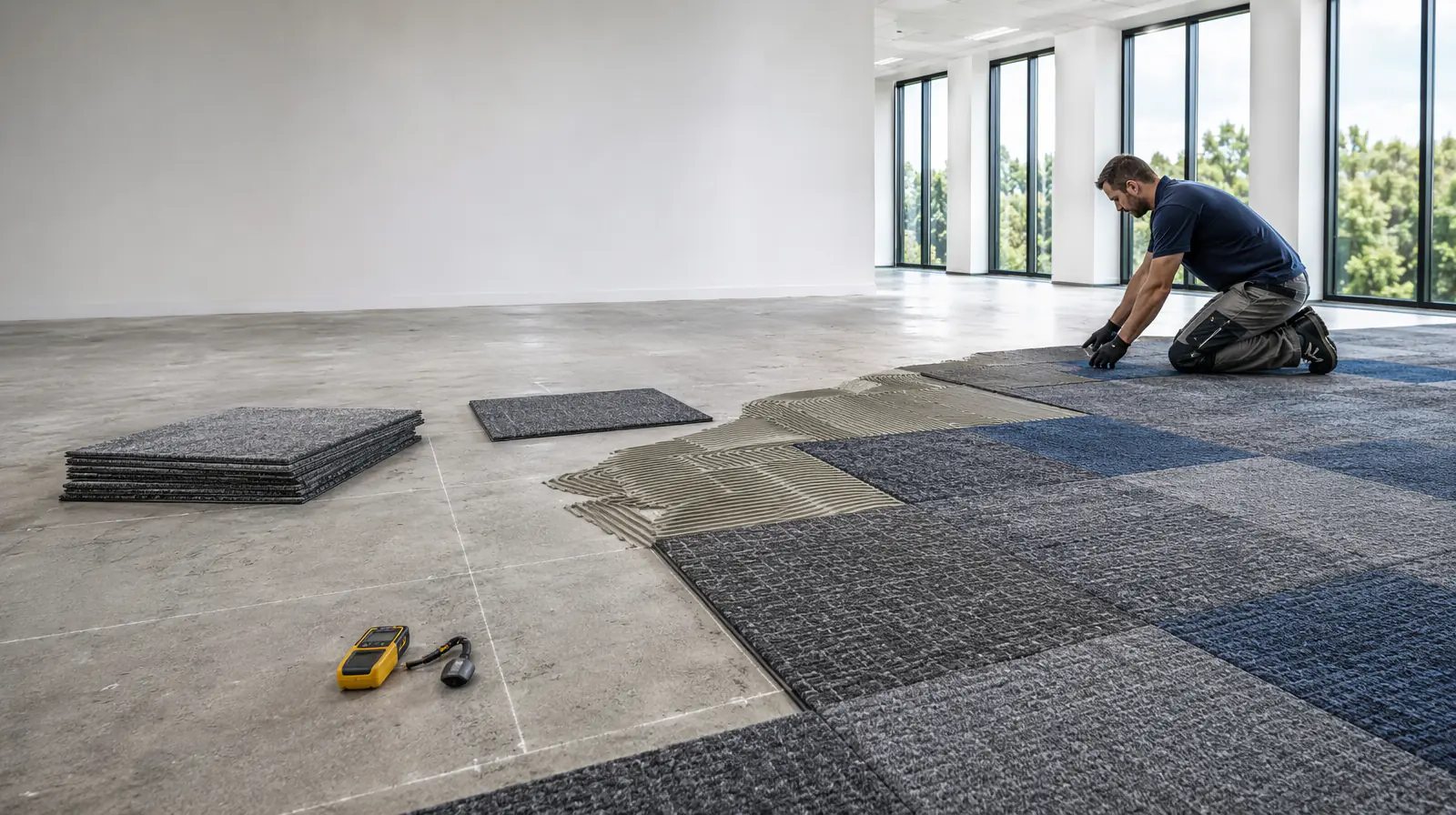
Pain Point Addressed
A tile sample can be approved while the concrete, preparation layers and underlay proposal remain unresolved. A clear buying brief keeps those decisions visible before ordering.
Can Carpet Tiles Go Over Concrete—and Do They Need Underlay?
Commercial carpet tiles can be considered for a concrete subfloor, but the useful answer is conditional: approve the exact tile, backing, fixing system and prepared slab together. Do not add a separate soft underlay by default. Ask for the proposed layers and their written compatibility before specifying a cushion beneath modular tiles.
For an importer, distributor or fit-out contractor, this is an ordering decision as well as a site decision. A colour sample can be accepted while the concrete review is still open. Keep those approvals separate so that an attractive sample or a low material price does not accidentally become permission to install.
This guide helps buyers prepare the concrete and underlay brief. For the separate decision about matching an attachment product to the selected backing and substrate, use the adhesive and subfloor compatibility guide.
What Does “Underlay” Mean in Your Quotation?
Before comparing quotations, ask each party to describe the layer it means. “Underlay included” is too ambiguous for a commercial purchase order. It could refer to a separate soft cushion, material already attached to the tile, or preparation work beneath the floor. Those are different purchasing decisions.
| Item in the proposal | Question for the buyer to resolve | Evidence to request |
|---|---|---|
| Separate soft cushion or pad | Is this extra layer part of the approved modular tile assembly for this zone? | Exact product reference, proposed fixing arrangement and applicable written compatibility. |
| Integral tile backing | What is supplied as part of the carpet tile itself? | Confirmed construction for the ordered reference; distinguish it from an added site layer. |
| Patching or smoothing layer | Which surface condition is the preparation contractor addressing? | Named preparation product, proposed extent and compatibility review. |
| Primer or surface treatment | Why is it required between these particular materials? | Purpose, named product and applicable system instructions. |
| Moisture mitigation system | Which assessed condition is it intended to address? | Site assessment, nominated system and documented acceptance/review responsibilities. |
This is a quotation vocabulary check, not approval to combine the listed layers. Not every project requires every item.
Ask for one bottom-to-top assembly description rather than five independent “suitable” statements. For example, record the existing slab, any retained layer, proposed preparation, fixing and exact carpet tile. Add a separate underlay only if it is actually proposed and reviewed. A drawing can show the proposed order without claiming that the assembly has been accepted.
Use the carpet tile backing comparison guide to clarify the supply construction. A backing label by itself does not establish the allowable site layers or verify acoustic, moisture or rolling-load performance.
Build a Concrete Site Record Before Selecting Preparation
CRI 104 identifies written reporting of concrete condition and manufacturer requirements for moisture, pH and preparation as part of commercial carpet installation planning. Use that as a reason to request a site record; do not turn an industry reference into a universal numeric acceptance limit for every product.
The buyer’s job is to make the missing information visible and assign it to someone who can evaluate it. A quotation spreadsheet should not silently replace an installer’s assessment. If an answer is unknown, record it as open rather than entering “standard concrete” or selecting a guessed value.
- Identify the area. Give each floor or zone a reference tied to the current drawing. State whether it is a new slab, exposed existing slab or a renovation with retained material. Attach available photographs as context, not as a substitute for assessment.
- Identify the evidence. Ask who will provide the relevant site tests and condition report, which written acceptance requirements they will use, and which zones the results cover. Keep the report date and revision with the project record.
- Identify the proposed response. Have the responsible contractor describe the preparation or mitigation being proposed and the layers it introduces. Separate work already included in the price from work awaiting assessment.
- Identify the reviewer. Name the party responsible for checking the complete proposal against the selected flooring/fixing instructions and project requirements. Record unresolved conflicts and a decision date.
- Identify the handover. State which record authorizes installation and who receives it. A logistics arrival date, sample sign-off or payment milestone should not stand in for that record.
Ask about changes between the assessment and installation: another trade may alter the surface, a different preparation product may be substituted, or a revised fit-out may change the zone use. Put the person responsible for reporting those changes in the brief. This is more useful than assuming one report covers every later version of the floor.
Choose an Underlay Review Path, Not a Generic Pad
A named modular flooring system can have specific underlay and backing rules. Interface’s APAC installation document is one example of product-specific distinctions; its named systems and exceptions are not transferable to VCARPETS tiles. The procurement lesson is to ask for the applicable document for the actual proposal.
| Situation | Next procurement action | Decision to keep open |
|---|---|---|
| No separate cushion is proposed | Request the nominated fixing and preparation assembly for the exact tile. | Do not interpret absence of a cushion as approval of an untreated slab. |
| A cushion is requested for comfort or noise | Explain the project objective and ask for a compatible assembly proposal and relevant evidence. | Do not claim the requested result from cushion thickness or a photograph. |
| The design calls for a raised floor or another intermediate layer | Describe that actual substrate and its interfaces separately. | Do not reuse a bare-concrete assessment for a different installation surface. |
| An underlay is offered as an optional extra | Ask for its reference, role, fixing arrangement and effect on the proposed assembly. | Keep the option out of the approved order until the required review is complete. |
| The site condition is not yet established | Request an initial product quotation with site preparation clearly excluded or provisional as agreed. | Do not describe the preliminary supply proposal as ready for installation. |
If the project objective is acoustic performance, ask which result, test method and assembly the specification requires. If the objective is use under office chairs, state the chair traffic and zone. Keep those requirements in the review brief; this article does not assert a rating or a compatible cushion option for any linked product.
For desk zones, the rolling-chair fit-out guide helps describe use conditions. It complements the concrete brief rather than approving the installation system.
Treat Existing Adhesive and Unknown Layers as Review Items
For a renovation, describe what remains on the slab before asking for an installed price. “Remove old carpet” and “deliver a surface accepted for the new assembly” can be different scopes. Ask the contractor to state the assessment, preparation and disposal responsibilities in its own proposal.
Do not choose grinding, chemical removal, encapsulation or a covering layer from a photograph of unknown residue. Unidentified or potentially hazardous material requires qualified assessment before disturbance. This guide does not provide a removal procedure or decide the local safety obligations.
In the commercial comparison, put unresolved residue work on a separate line with an owner and decision point. If one bidder includes an assessed preparation scope and another only quotes carpet supply, their totals answer different questions. Request a scope reconciliation before treating the lower number as a saving.
Use Two Approvals: Product Selection and Site Release
A distributor may need a supply quote before its customer completes the site assessment. That is workable when the order record distinguishes commercial product selection from authorization to install. Do not label either stage simply “approved” without saying what has been accepted.
| Approval record | What it should identify | What it does not establish |
|---|---|---|
| Product and sample selection | Tile reference, agreed construction, colour/layout reference, quantity basis and quotation revision. | That the concrete, site preparation or proposed fixing assembly has been accepted. |
| Site assembly review | Zone, slab evidence, preparation layers, fixing, any separate underlay, exact tile and reviewer decision. | That a different tile, layer or zone can use the same decision without review. |
| Installation release | Current accepted assembly/drawing revisions, outstanding conditions resolved and responsible authorization. | That a future substitution or changed site condition is already authorized. |
Use the sample approval checklist for the product record, then retain the concrete review alongside it. Approval of pattern and colour should remain traceable to the chosen tile rather than being silently extended to a different backing.
For a staged office fit-out, distinguish zones that are ready from zones awaiting information. This lets the buyer discuss supply and delivery planning without disguising an unresolved site condition. Any decision to order before the review is complete should state its assumptions and who will resolve them.
Copy This Site-Readiness Brief into Your RFQ
Use the following record in a project email or procurement schedule. An initial enquiry can be short; complete the technical lines with the responsible installer or specialist as the proposal develops. This is a working record, not a certificate or a VCARPETS site inspection form.
| Record field | Information to provide or request |
|---|---|
| Project and zone | Country/city, building use, approximate area and drawing reference. |
| Tile proposal | Product reference or preferred appearance; confirm construction and module through the quotation. |
| Existing surface | Known slab/retained-layer description, available site report and assessment owner. |
| Test and acceptance basis | Applicable system instructions, required evidence, report location and named reviewer. |
| Proposed layers | Bottom-to-top list with named products, including any separate cushion or treatment. |
| Scope and exclusions | Who prices preparation, mitigation, fixing, installation and any unresolved work. |
| Status and decision | Open, under review or accepted for the stated scope; reviewer, revision and date. |
| Change trigger | Which product, layer, zone or site changes must return for review. |
| Commercial brief | Area/quantity basis, destination, target project date and sample needs. |
For quantity planning, keep net room area separate from reviewed cutting allowances, order rounding and retained replacement stock. Those figures need the selected module and layout. The tile layout approval guide helps build that separate record; do not add a universal waste percentage to compensate for an unknown layout.
When comparing suppliers, ask them to respond to the same product brief. Ask the site contractor to respond to the same preparation scope. Keeping those comparisons separate makes it easier to identify a missing cost or responsibility before a purchase order is issued.
Example: An Office Order with an Unresolved Underlay Request
Consider a hypothetical office refurbishment. The buyer likes a grey tile sample and asks whether a soft pad can be added for comfort. The installer has not yet confirmed the retained slab coating. This is a planning example, not a VCARPETS delivered project or a tested assembly.
First, record the tile sample as an appearance preference and request confirmation of the proposed construction. Next, record the separate pad as an option awaiting compatibility review. Ask the installer to assess the retained surface and describe the proposed preparation and fixing. Keep the material quotation distinct from unconfirmed site work.
If the final review changes the backing or omits the pad, update the product and assembly records before releasing the affected scope. If another floor later has a different retained layer, do not simply copy the first floor’s acceptance. Identify the difference and ask the reviewer what evidence is needed.
This approach does not promise a particular technical result. It makes the buying decision reviewable: the buyer can see which product is being quoted, which site assumptions remain open and which party must resolve them.
Request a Carpet Tile Supply Proposal with a Clear Site Brief
VCARPETS, operated by Tianjin Vcarpets Global Commercial Carpet Co., Ltd., accepts B2B project enquiries. Bulk trade terms are FOB Tianjin Port. Product construction, sample arrangements, commercial quantities and timing are confirmed for the specific proposal; this guide does not include local installation or site preparation in a material quotation.
Browse carpet tiles and, where that construction fits your brief, review PP/PVC-backed office carpet tiles. Neither link establishes that a specific slab, separate underlay or fixing method has been accepted.
Send the project use, approximate area, preferred product or design, destination and required date. Add the known slab condition and say which site information is still open. If you already have a drawing or site report, mention it so the relevant follow-up can be arranged; the current contact form does not provide a file-upload field.
Request a carpet tile project quotation with these details. You can begin with a preliminary enquiry and distinguish the product supply discussion from the site review still to be completed.
Frequently Asked Questions
Can commercial carpet tiles be installed over concrete?
They can be considered when the exact tile, backing, fixing system and prepared slab are approved together. A product sample approval alone does not release the concrete for installation. Ask the project installer or nominated reviewer to identify the applicable instructions and unresolved site conditions.
Do carpet tiles need a separate soft underlay over concrete?
Do not add one by default. A separate cushion is a proposed layer in the floor assembly and needs written compatibility approval for the selected tile, fixing and use. Integral carpet backing, a smoothing layer and moisture mitigation are different items; none gives blanket permission to add a loose pad.
Does a smoothing compound solve a concrete moisture problem?
Do not treat smoothing and moisture mitigation as interchangeable. Ask the nominated system supplier to identify the purpose and compatibility of every proposed layer, and the installer to record the site acceptance requirements. A floor that looks smooth is not, by appearance alone, released for installation.
Can old adhesive stay under the new carpet tiles?
That requires a site-specific assessment. Record what the existing material is and ask the responsible specialist for a compatible preparation proposal. Do not specify grinding, chemical removal or covering unknown material from a photograph. Unidentified or potentially hazardous material needs qualified assessment before disturbance.
What moisture limit should the quotation use?
Use the written requirements for the nominated complete system and the project, including the relevant test method and reviewer. This guide sets no universal moisture or pH threshold. A value or exception from another brand, backing or adhesive is not evidence for the VCARPETS proposal.
Can VCARPETS quote before the site assessment is complete?
Send the project use, approximate area, preferred tile reference, destination and required date for an initial product discussion. Identify missing site information as open. Product selection, specification, sample arrangements and commercial timing remain subject to confirmation; a preliminary supply quote is not site approval. Bulk trade terms are FOB Tianjin Port.
What changes should reopen the installation review?
Review a change to the tile reference or backing, fixing product, separate underlay, preparation layers, affected zone or planned use. Ask the responsible reviewer whether new evidence or approval is required, and record the revised decision before the changed assembly is released.
Sources and Applicability
Industry reference: CRI 104, Standard for Installation of Commercial Carpet, sections on concrete testing and preparation. Product-specific example: Interface APAC carpet tile installation instructions, including its named underlay/backing distinctions. Both were consulted on 18 October 2026; their requirements must be read in their own scope.
These references inform the limited technical context above. The site-readiness brief, approval records and hypothetical example are procurement tools developed for this guide. They are not performance evidence for VCARPETS, and another manufacturer’s instructions or exceptions do not approve a VCARPETS product. Confirm the current applicable documents for the actual proposal.
Buyer Questions
Frequently Asked Questions
Can commercial carpet tiles be installed over concrete?
They can be considered when the exact tile, backing, fixing system and prepared slab are approved together. A product sample approval alone does not release the concrete for installation. Ask the project installer or nominated reviewer to identify the applicable instructions and unresolved site conditions.
Do carpet tiles need a separate soft underlay over concrete?
Do not add one by default. A separate cushion is a proposed layer in the floor assembly and needs written compatibility approval for the selected tile, fixing and use. Integral carpet backing, a smoothing layer and moisture mitigation are different items; none gives blanket permission to add a loose pad.
Does a smoothing compound solve a concrete moisture problem?
Do not treat smoothing and moisture mitigation as interchangeable. Ask the nominated system supplier to identify the purpose and compatibility of every proposed layer, and the installer to record the site acceptance requirements. A floor that looks smooth is not, by appearance alone, released for installation.
Can old adhesive stay under the new carpet tiles?
That requires a site-specific assessment. Record what the existing material is and ask the responsible specialist for a compatible preparation proposal. Do not specify grinding, chemical removal or covering unknown material from a photograph. Unidentified or potentially hazardous material needs qualified assessment before disturbance.
What moisture limit should the quotation use?
Use the written requirements for the nominated complete system and the project, including the relevant test method and reviewer. This guide sets no universal moisture or pH threshold. A value or exception from another brand, backing or adhesive is not evidence for the VCARPETS proposal.
Can VCARPETS quote before the site assessment is complete?
Send the project use, approximate area, preferred tile reference, destination and required date for an initial product discussion. Identify missing site information as open. Product selection, specification, sample arrangements and commercial timing remain subject to confirmation; a preliminary supply quote is not site approval. Bulk trade terms are FOB Tianjin Port.
What changes should reopen the installation review?
Review a change to the tile reference or backing, fixing product, separate underlay, preparation layers, affected zone or planned use. Ask the responsible reviewer whether new evidence or approval is required, and record the revised decision before the changed assembly is released.
Turn This Guide Into a Quote
Send Your Project Requirements After Reading This Guide
If this topic matches your project, send the carpet application, estimated area, destination, and required date. VCARPETS can recommend the related product path and reply with sample, MOQ, lead time, and quotation details.
Email: sales@vcarpets.com
Continue Your Specification
Related Products


Browse the Full Range