
Commercial Carpet Tile RFQ Checklist for B2B Buyers
A practical RFQ and tender-response template for buyers who need suppliers to quote the same construction, evidence, deviations and delivery assumptions.

Pain Point Addressed
A carpet tile tender can collect several prices while still hiding different constructions, unapproved alternatives, missing evidence, scope exclusions and provisional quantities.
Direct Answer: Issue One Requirement and Response Schedule
A comparable commercial carpet tile RFQ should give every supplier the same project brief and require a line-by-line response. For each requirement, record the exact offered construction, response status, supporting document or sample, deviation, commercial effect, responsible reviewer and decision deadline. Keep product approval, quantity approval and order release as separate decisions.
This method exposes where two quotations use different fibre, backing, tile size, evidence, packing, installation assumptions or trade scope. It also lets a buyer begin with preliminary information without allowing an estimate to become an accidental final specification.
| RFQ control | Buyer states | Supplier responds |
|---|---|---|
| Requirement | Tender clause, drawing, zone and decision needed | Exact offered product or construction |
| Status | Allowed response terms and approval route | Confirmed, alternative proposed, pending evidence, excluded or not applicable |
| Evidence | Document or sample required and review purpose | Construction-matched reference and availability |
| Commercial effect | Required quantity basis, scope and milestone | Price unit, assumption, exclusion and timing effect |
| Decision | Named reviewer and deadline | Open point, owner and requested action |
The status labels are procurement controls for comparison. They do not certify a product or replace the project's tender rules and professional review.
Confirm Project Scope and Quantity
Start with the building type, installation area and expected traffic. Office workstations, corridors, meeting rooms, education spaces and retail areas can require different carpet tile constructions even when the color looks similar.
Send the net area, estimated waste allowance, tile size, phase plan and whether spare stock is required. For renovation projects, note whether work must be staged around occupied spaces or weekend installation windows.
If the final drawing is not ready, give the best working estimate and mark it as provisional. Suppliers can then quote a sensible range instead of treating the inquiry as a generic square-meter price.

Specify Construction, Backing and Pile Details
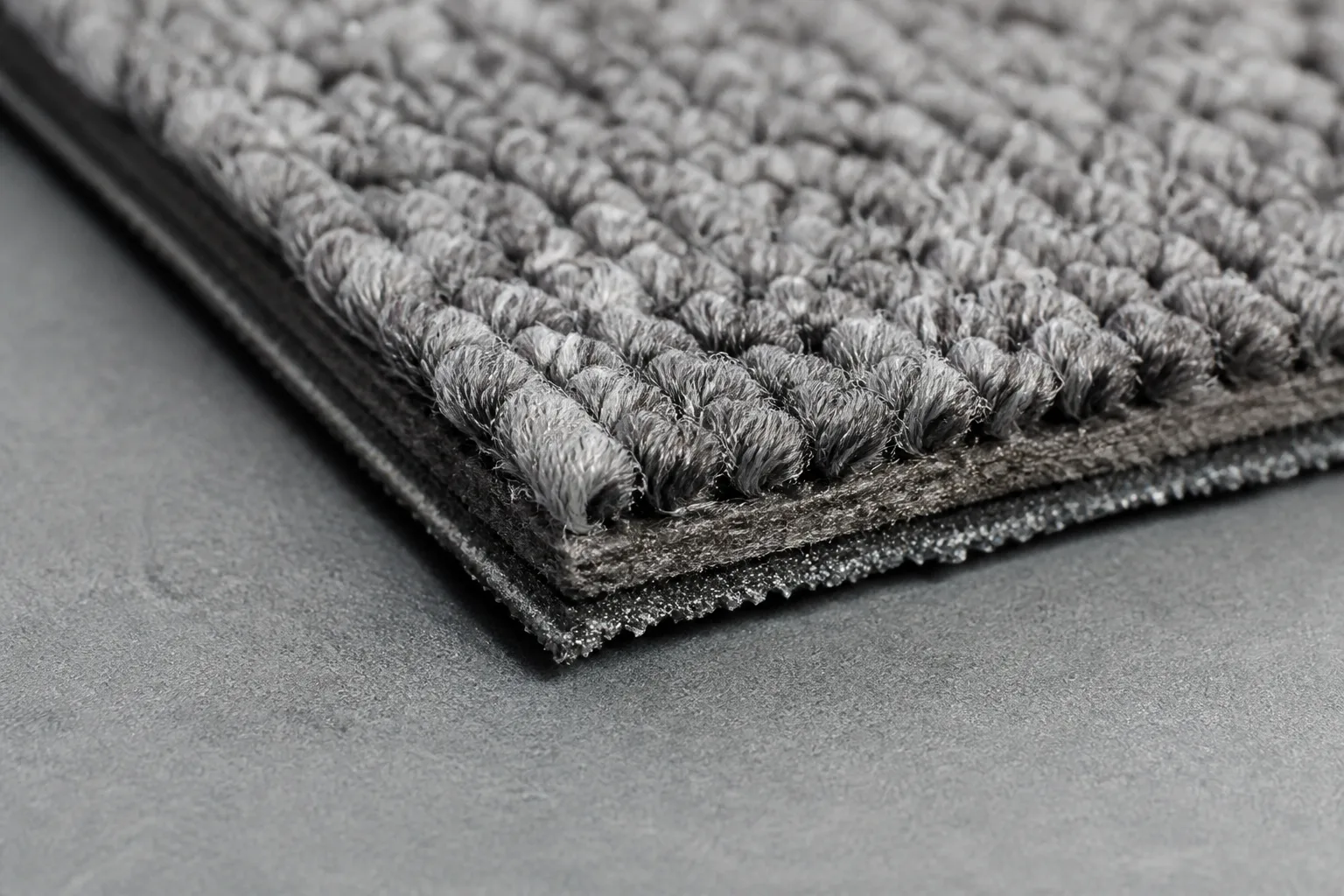
A carpet tile RFQ should identify fiber, pile style, backing type, tile size, pile weight target, color family and any performance documents required by the destination market.
Do not compare prices unless the construction basis is clear. A PP tile, nylon tile, bitumen backing, PVC backing or PVC-free backing can solve different project needs and lead to different cost structures.
Ask suppliers to confirm the construction in writing, not only by photo. Photos help with appearance, but the quotation should still name the material, backing and sample approval route.
Describe Subfloor and Adhesive Conditions
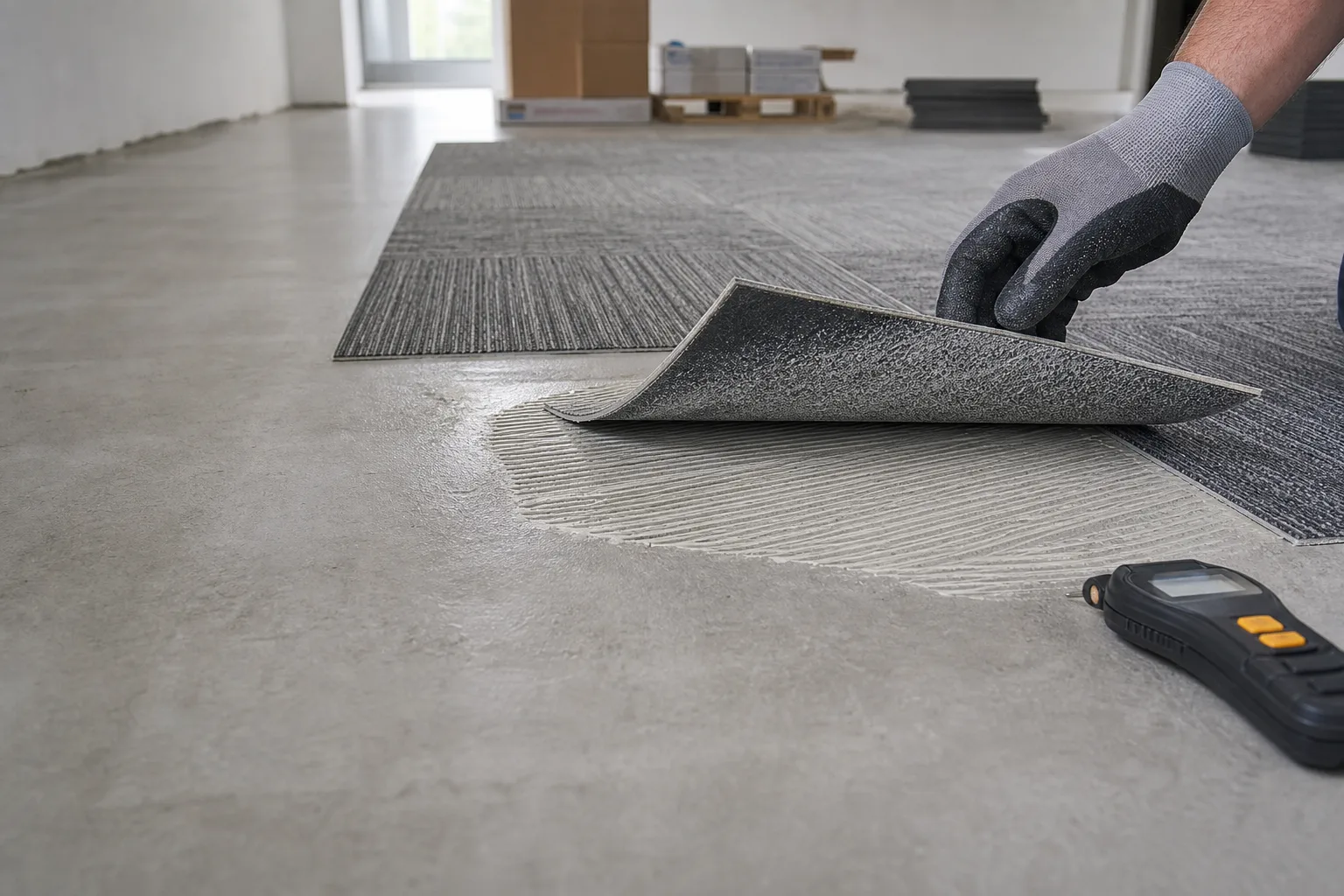
Subfloor condition can change the installation method and risk level. Tell the supplier whether the floor is concrete, raised access floor, old adhesive, existing carpet, tile surface or another substrate.
Mention moisture risk, dust, uneven areas, previous adhesive residue and whether the installer plans full-spread adhesive, tackifier or another method. These details help avoid claims that start after installation.
If the project is still in planning, ask the supplier what site information they need from the installer before final production or shipment.
Control Sample Approval and Color Matching
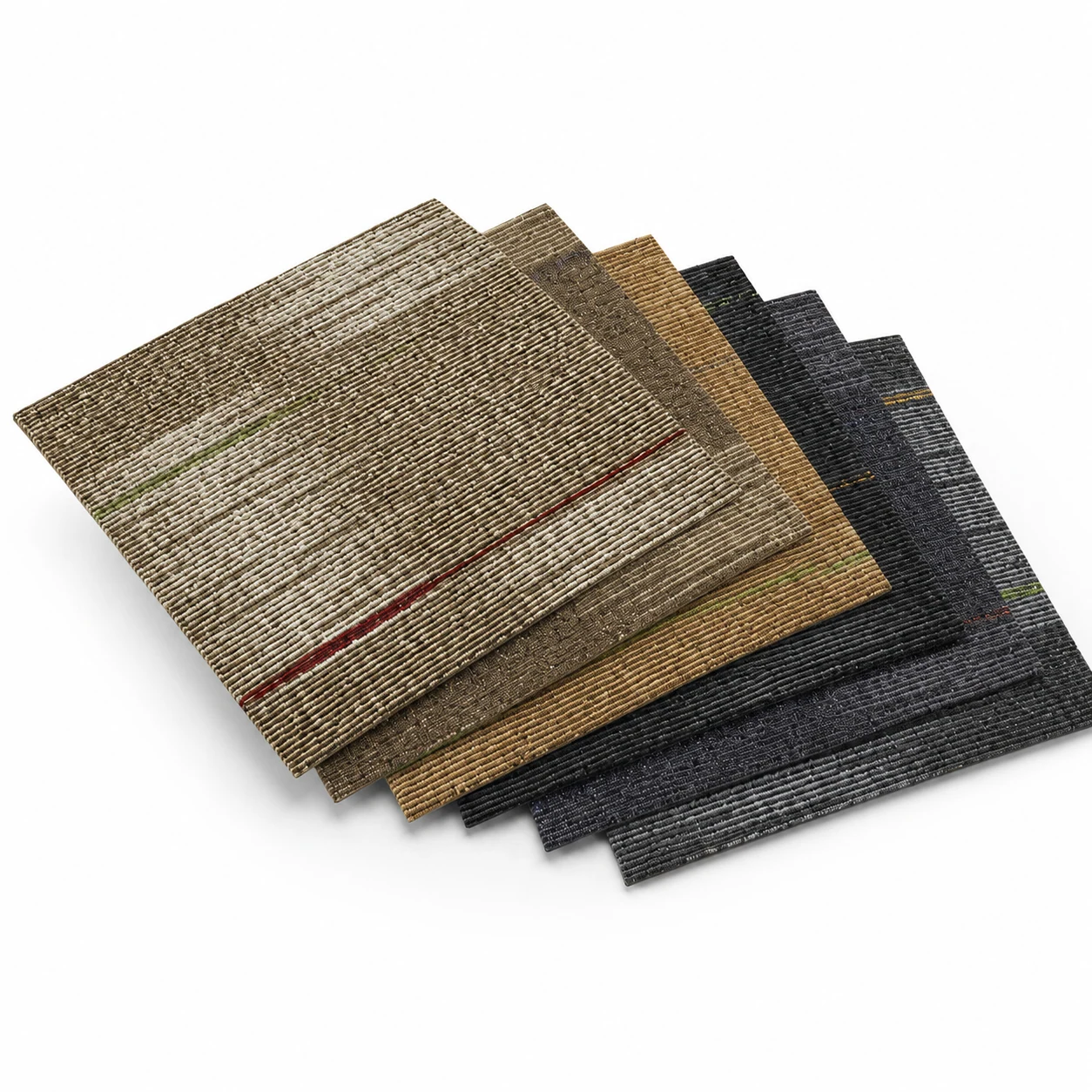
State whether the buyer needs stock samples, custom color samples, mock-up material, production sample approval or a physical sample board before purchase order confirmation.
For office, education and retail projects, color variation, lighting and furniture context can affect final approval. Ask who approves the sample and how many days the review normally takes.
A clear sample path prevents the factory from planning bulk production too early and helps procurement align quotation validity with real approval timing.

Plan Spare Stock, Cartons and Delivery
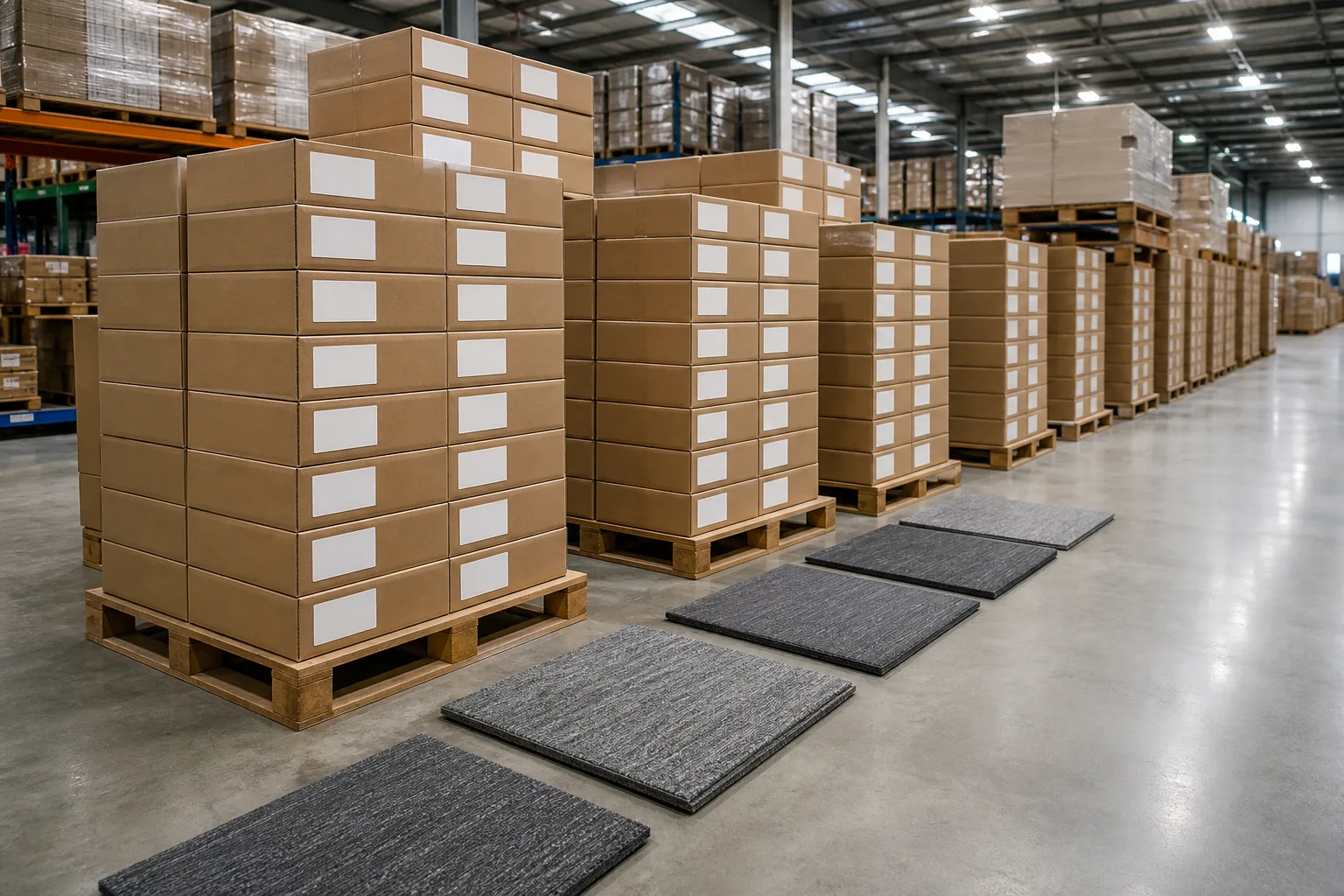
Include the destination country, delivery city, preferred Incoterms, target arrival date, packaging request and whether the buyer wants spare tiles for maintenance after handover.
For phased projects, ask whether cartons need to be marked by floor, zone or installation sequence. This can save time on site and reduce confusion for contractors.
Spare stock is not only a cost item. It protects future replacement work when a tenant area, corridor or chair-wheel zone needs localized repair.
RFQ Fields to Send to VCARPETS
The current contact form requires company, business email, product type and quantity or area. Add the destination, intended use, sample needs and target receiving date to explain the project. Name, WhatsApp and other additional details are optional; you do not need every technical answer before starting a clearly marked preliminary inquiry.
For faster handling, use a short format: product, quantity, country, application, backing preference, sample need, delivery target and special documents. This gives the sales and technical team enough context to respond with a practical quotation path.
The contact form accepts your project summary, not file uploads. Describe any available floor plan and its revision in the message, then arrange supporting-file transfer through the existing sales conversation or email sales@vcarpets.com. Do not send private customer correspondence to explain a requirement. Keep final price and technical confirmations in a written quotation.

Turn the RFQ into a Comparable Tender Response
For an office, hotel, education or other commercial project, send the same conditions to each shortlisted supplier. Ask the supplier to place the offered product, evidence, deviation and quotation assumption beside every requirement instead of presenting an alternative as automatically equivalent. Keep tender response, sample approval, technical review, commercial award and bulk release as separate records.
Build a Requirement Register before Comparing Price
| Requirement group | Buyer input | Supplier response field |
|---|---|---|
| Project and zone | Country, building use, room or floor, traffic and chair or trolley use | Proposed product by zone and the use assumption behind it |
| Construction | Fibre, pile, backing, tile size, colour/design and permitted alternatives | Exact offered configuration, product reference and any difference |
| Quantity | Drawing revision, net area, layout allowance, retained stock and phases | Quoted unit, purchase quantity, rounding and provisional assumptions |
| Sample and appearance | Sample purpose, colour reference, layout direction and approver | Sample type, represented construction and open appearance decisions |
| Evidence | Project-specific document and test-report needs | Available construction-matched record, limitation or pending item |
| Installation interface | Substrate, fixing, transition, access and working-hour assumptions | Supplier boundary plus items requiring installer or project review |
| Packing and delivery | Destination, carton marks, release phases, required milestone and Incoterm | Packing basis, named shipment point, timing assumptions and exclusions |
Ask for information relevant to the actual project. This table does not create a universal document list, performance threshold, sample format, MOQ or lead time.
Use Status Labels That Show What Is Still Open
| Response status | Use it when | What must follow |
|---|---|---|
| Confirmed | The exact offered construction and supporting record are identified | Reference the quotation, product sheet, sample or document revision |
| Alternative proposed | The offer differs from the stated requirement | Describe the difference, evidence, commercial effect and approval needed |
| Pending evidence | A requested record is not yet supplied or its scope is unresolved | Name the missing item, owner and review deadline; do not mark compliant |
| Excluded | The supplier has not included the item or service | State who is expected to supply, install, review or pay for it |
| Not applicable | The requirement does not apply to the proposed scope | Give the reason and obtain the buyer's acceptance where needed |
These labels make comparison clearer. The buyer, consultant or other appointed approver decides acceptance under the actual tender.
Control an Alternative or Approved-Equal Request
- Name the original requirement. Cite the clause, drawing, room or product basis that the proposal changes.
- Identify the alternative exactly. State fibre, pile, backing, tile size, colour or design, fixing assumptions and product reference rather than using a generic family name.
- Compare the decision criteria. Show the requested evidence, sample scope, installation or maintenance effect and any project-specific performance question.
- Show the commercial effect. Record quotation unit, quantity conversion, MOQ or production feasibility when confirmed, packing, timing and any price or scope change.
- Record the disposition. Name the approver, decision date, conditions and current revision. Keep the original and alternative on separate lines until accepted.
Public carpet specifications illustrate why this separation matters. UFGS 09 68 00 lists installation drawings, product data, carpet samples, test reports, certificates, instructions and closeout information as different submittal categories. A 2026 public carpet-replacement tender separately required written pre-bid approval for proposed equals and allowed performance data, samples and guarantees to be requested. Review the UFGS 09 68 00 carpeting specification and the 2026 public carpet-replacement tender example for their original project context. Those are project examples, not VCARPETS certifications, universal buyer rules or a promise that every document is available for every construction.
Separate FOB Carpet Supply from Local Project Scope
| Scope line | VCARPETS quotation input | Buyer or project input |
|---|---|---|
| Carpet construction | Quoted product, configuration, sample and available product records | Intended use, required criteria and approval decision |
| Order quantity | Quotation unit, packing basis and confirmed order quantity | Net area, layout/cutting allowance, retained stock and drawing status |
| Export supply | FOB Tianjin Port supply scope, packing and available export documents as quoted | Forwarder, onward freight, import and destination arrangements unless the quotation says otherwise |
| Site work | Product and installation information available for the nominated construction | Site measurement, substrate approval, local materials, installation and local compliance review |
| Release | Supplier confirmation of accepted commercial and production conditions | Authorized approval of product, quantity, sample, documents and open exceptions |
The written project quotation and signed order records control the actual scope. This guide does not appoint VCARPETS as site measurer, installer, consultant, importer or local compliance approver.
Separate Net Area, Ordering Pieces and Retained Stock
A hotel or office carpet tile quotation should identify the zone, drawing revision, selected construction, colorway and intended layout. Net floor area is the starting point, not the final carton order. A striped design may change appearance when adjacent tiles change direction; confirm the permitted arrangement using the product instructions and physical sample, not a photograph alone.
| Quantity record | Buyer input | Confirmation before ordering |
|---|---|---|
| Net installation area | Measured coverage by room type or zone and drawing revision | Which dimensions are measured and which remain provisional |
| Installation allowance | Separate proposed allowance for the reviewed layout | Whether cuts and boundaries are already included; avoid adding the same allowance twice |
| Retained replacement stock | Separate requirement by color, construction and phase | Batch identification, labeling and storage responsibilities |
| Ordering pieces | Tile size and proposed purchase quantity | The relationship to net area and agreed allowances |
| Carton quantity | Requested packing or release phases | Actual pieces per carton, packed area, carton dimensions and gross weight |
These are RFQ review fields, not a universal waste percentage or a product packing promise.
For nominal 50x50cm tiles, one tile represents 0.25m² and four tiles represent 1m² before layout allowances. If a specific quotation confirms 24 pieces per carton, that carton represents 6m². The 24-piece figure is an arithmetic example, not the packing specification of every product. Confirm the actual unit before converting area to cartons or comparing freight.
Ask whether a quoted weight is per tile, per square meter or per packed carton, and whether it is net or gross. Do not combine a marketplace single-item package weight with a bulk carton count. Different colors and phased releases should have separate quantities where the purchasing scope requires them.
Agree Who Confirms the Missing Information
| Decision | Responsible input | What the RFQ should record |
|---|---|---|
| Scope and timing | Buyer or procurement team | Destination, intended use, phase plan and required receiving date |
| Measurement and layout | Project designer or local installer | Current drawing, verified dimensions, tile direction and site interfaces |
| Product and packing | Supplier for the nominated construction | Fiber/backing, sample reference, actual packing unit and quotation assumptions |
| Purchase release | The parties named in the project approval process | Agreed quantity, sample/specification revision, terms and open conditions |
Responsibilities must be agreed for the actual project. This guide does not offer on-site measurement, installation or consultant approval.
A Copyable Carpet Tile RFQ and Tender-Response Brief
Please review our carpet tile requirement and return a line-by-line response. Identify the exact offered construction, response status, evidence reference, deviation, exclusion and commercial assumption. Items not yet finalized must be treated as preliminary rather than approved for purchasing.
- Project: Country and city, building use, hotel or office zones, and new installation or refurbishment.
- Quantities: Net area by zone, tile size, proposed installation allowance and separate retained replacement stock.
- Product: Preferred carpet tile or reference, fiber/backing choice, colorway and permitted alternatives.
- Layout: Drawing identifier and revision, measurement status, tile direction and any phased release requirements.
- Approval: Sample needs, existing sample reference and the technical documents required for the nominated construction.
- Tender response: For each requirement, mark confirmed, alternative proposed, pending evidence, excluded or not applicable, and explain every open point.
- Packing and timing: Destination, carton-label requirements, target sample review and target receiving date.
- Quotation basis: Confirm pieces and area per carton, packing dimensions, gross weight and the named FOB shipment point with inclusions and exclusions.
Buyer Questions before Sending the RFQ
- Can I inquire without final drawings? Yes. State the estimated area, use and destination, mark the drawing status as preliminary, and ask which information is required before a final quantity can be approved.
- Is spare stock the same as cutting allowance? No. Cutting allowance relates to the planned installation; retained stock supports later replacement. Record them separately and avoid double-counting.
- Can I upload drawings in the contact form? The current form has no upload field. Summarize the requirement there and arrange file transfer through the existing sales conversation or email.
- Does a PP sample approve a nylon alternative? No. Confirm the sample and documents for each nominated configuration; a similar color or pattern does not establish equivalent construction or performance.
Buyer Questions
Frequently Asked Questions
What should a commercial carpet tile RFQ include?
Include the project use and destination, zone quantities and drawing revision, required tile construction, permitted alternatives, sample route, document requirements, installation assumptions, packing, trade terms, target milestones and a response field for every deviation or exclusion. Mark preliminary information as provisional.
How should a supplier answer a carpet tender requirement?
The supplier should identify the exact offered product or construction, state whether each requirement is confirmed, proposed as an alternative, pending evidence, excluded or not applicable, and reference the quotation, product sheet, sample or other record supporting that status. A blank yes or generic compliant statement is not enough for comparison.
Is an alternative carpet tile automatically an approved equal?
No. An alternative remains a proposal until the buyer or appointed project approver accepts it under the actual tender procedure. Compare the construction, appearance, required evidence, installation implications, quantity, commercial effect and approval deadline before treating it as accepted.
Should cutting allowance and retained spare tiles be combined?
No. Keep net installation area, layout or cutting allowance, retained replacement stock and carton rounding on separate lines. This reduces double counting and makes later batch and replacement planning easier to review.
Can a buyer request a VCARPETS quotation without final drawings?
Yes. Send the intended use, estimated area or quantity, preferred construction, destination, sample or document needs and project timing. Identify which drawings, measurements and specifications are preliminary so the response can state assumptions and the information required before final order approval.
What is the supply basis for VCARPETS bulk carpet quotations?
VCARPETS bulk supply is quoted FOB Tianjin Port unless a project quotation states otherwise. The written quotation should identify the named shipment point, carpet supply scope, packing and documents, while onward freight, import, local delivery, substrate preparation and installation responsibilities are agreed separately for the actual project.
Turn This Guide Into a Quote
Send Your Project Requirements After Reading This Guide
If this topic matches your project, send the carpet application, estimated area, destination, and required date. VCARPETS can recommend the related product path and reply with sample, MOQ, lead time, and quotation details.
Email: sales@vcarpets.com
Continue Your Specification
Related Products


Browse the Full Range